








India’s private space sector is entering a new growth phase as the Department of Space has cleared two new space hubs in Gujarat and Tamil Nadu. These hubs are expected to support rocket manufacturing, payload development, satellite testing, and launch-related infrastructure. The move could help startups and private companies access advanced facilities without building everything from scratch.
India’s space economy is moving beyond government-led missions and entering a more industry-driven phase. In a major push for private space manufacturing, the Department of Space has approved two new space hubs in Gujarat and Tamil Nadu, aimed at strengthening India’s ability to build rockets, payloads, satellites, and launch-support systems.
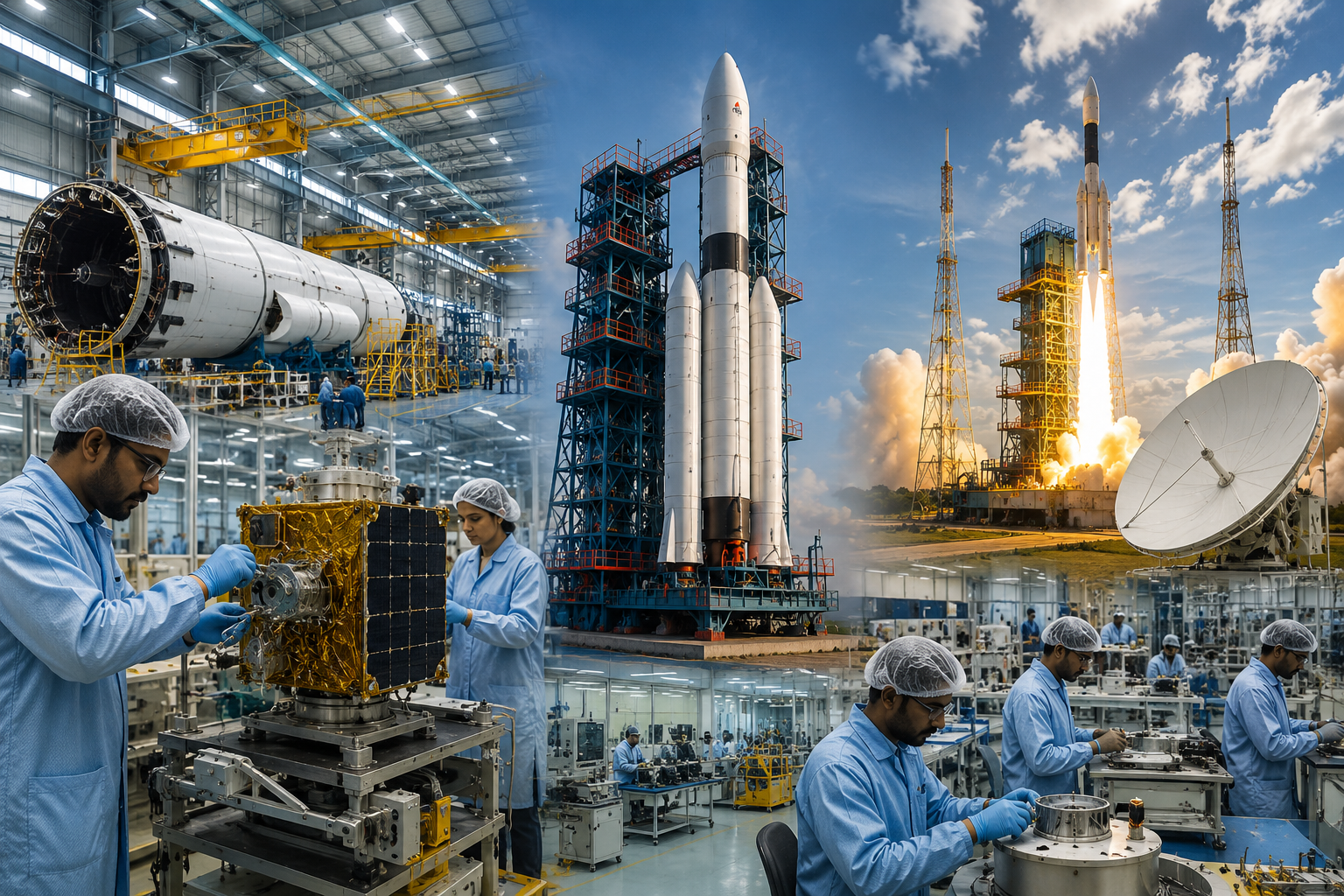
The new facilities are expected to work as Common Technical Facilities, giving private companies, startups, research groups, and manufacturers access to advanced infrastructure for testing, validation, integration, and production. This is important because space technology is not like ordinary manufacturing. A company building rocket components, satellite systems, or payload hardware requires high-end testing equipment, clean-room environments, quality validation systems, and engineering support. For many startups, these facilities are too expensive to build independently.
By creating shared infrastructure, India is trying to solve one of the biggest challenges in the private space sector: cost. The approval of these hubs means companies may be able to design, test, and scale their products faster while reducing dependency on limited facilities.
Why Gujarat and Tamil Nadu Matter
Gujarat and Tamil Nadu are not random choices. Both states have been strengthening their industrial and technology ecosystems, and both can support different parts of the space manufacturing value chain.
Gujarat’s proposed hub is expected to support space technology manufacturing, spacecraft systems, and payload-related development. Reports have also pointed to Khoraj near Ahmedabad as an emerging location for space-tech manufacturing activity. This can help Gujarat attract private space companies, component makers, electronics firms, and precision-engineering units.
Tamil Nadu, on the other hand, has a strong connection with launch vehicle manufacturing and the upcoming space ecosystem near Kulasekarapattinam. ISRO had earlier started construction of the SSLV Launch Complex at Kulasekarapattinam in Tamil Nadu, with construction formally beginning on March 5, 2025. This upcoming launch infrastructure can make Tamil Nadu strategically important for small satellite launches, private launch vehicles, and rocket-related manufacturing.
Together, these two hubs can help India build a more distributed space industry instead of keeping critical activities concentrated around a few traditional centres.
A Big Opportunity for Private Space Companies
India has already opened the space sector for private participation, and companies are increasingly working on satellites, launch vehicles, propulsion systems, payloads, and data-based space services. But for this industry to grow, companies need access to reliable manufacturing and testing facilities.
The new hubs could help startups move from prototype to production faster. A young company developing a satellite payload, for example, may need vibration testing, thermal testing, integration support, and quality checks before its system can be mission-ready. Without shared facilities, such companies may face long delays or high costs.
This is where the new Common Technical Facilities can become a game-changer. They can provide a bridge between idea, prototype, testing, certification, and commercial production.
For India, this also supports the larger goal of becoming a serious player in the global space economy. The world is seeing growing demand for small satellites, communication networks, Earth observation systems, navigation services, defence-linked space technologies, and commercial launches. If India can create a strong private manufacturing base, it can compete not only in launching satellites but also in building the hardware and systems behind them.
Why This Matters for India’s Space Future
India’s space journey has traditionally been driven by ISRO’s scientific achievements, including lunar missions, Mars exploration, satellite launches, and low-cost mission engineering. But the next phase of global space competition will not depend only on government missions. It will also depend on how fast private companies can innovate.
The United States, China, Europe, and other space powers are investing heavily in private and commercial space ecosystems. India cannot depend only on mission success stories; it also needs a strong industrial base that can manufacture, test, and export space technology.
The Gujarat and Tamil Nadu hubs can support this shift. They may help India create jobs in advanced manufacturing, attract investment, encourage space startups, and build a supply chain for components such as sensors, structures, electronics, propulsion parts, and satellite subsystems.
For readers following India’s technology rise, this development connects closely with the country’s wider push in semiconductors, 6G, defence technology, and advanced manufacturing. India is trying to move from being only a service-driven tech economy to becoming a deep-tech manufacturing economy.
A similar shift can already be seen in India’s digital infrastructure plans, and our earlier report on India’s 6G push and the next digital era explains how future technologies may transform everyday connectivity and industry.
The Road Ahead
The approval of the new space hubs is only the beginning. The real impact will depend on how quickly the facilities are built, how affordable they are for startups, how efficiently private firms can access them, and whether they can attract long-term investment.
If implemented well, these hubs can become more than just manufacturing centres. They can become innovation clusters where startups, academic institutions, suppliers, engineers, and large companies work together. This can help India build not just rockets and satellites, but a complete space economy.
For students, engineers, and young professionals, this also opens a new career direction. Space technology is no longer limited to astronauts or scientists. It now needs software engineers, mechanical engineers, data analysts, electronics specialists, AI experts, materials engineers, and business professionals. On The Thrive Journey, we have also explained how future technology careers are changing in How Students Can Build a Successful Career in the AI Era, and India’s space-tech expansion is another example of that shift.
India’s new space hubs in Gujarat and Tamil Nadu may not immediately produce dramatic headlines like a Moon mission or rocket launch, but their long-term impact could be deeper. They can strengthen the foundation behind future launches, private satellite networks, space startups, and India’s ambition to become a global space manufacturing power.
Source: Department of Space clears two new space hubs in Gujarat and Tamil Nadu
Read More: Latest News
Read More Interesting Content in My Blog Section of ‘The Thrive Journey’.