







A strong earthquake struck Afghanistan’s Hindu Kush region on Saturday evening, and tremors were felt across Delhi-NCR, Jammu and Kashmir, and parts of North India.
According to India’s National Centre for Seismology, the quake measured magnitude 6.2 and occurred at a depth of 215 km.
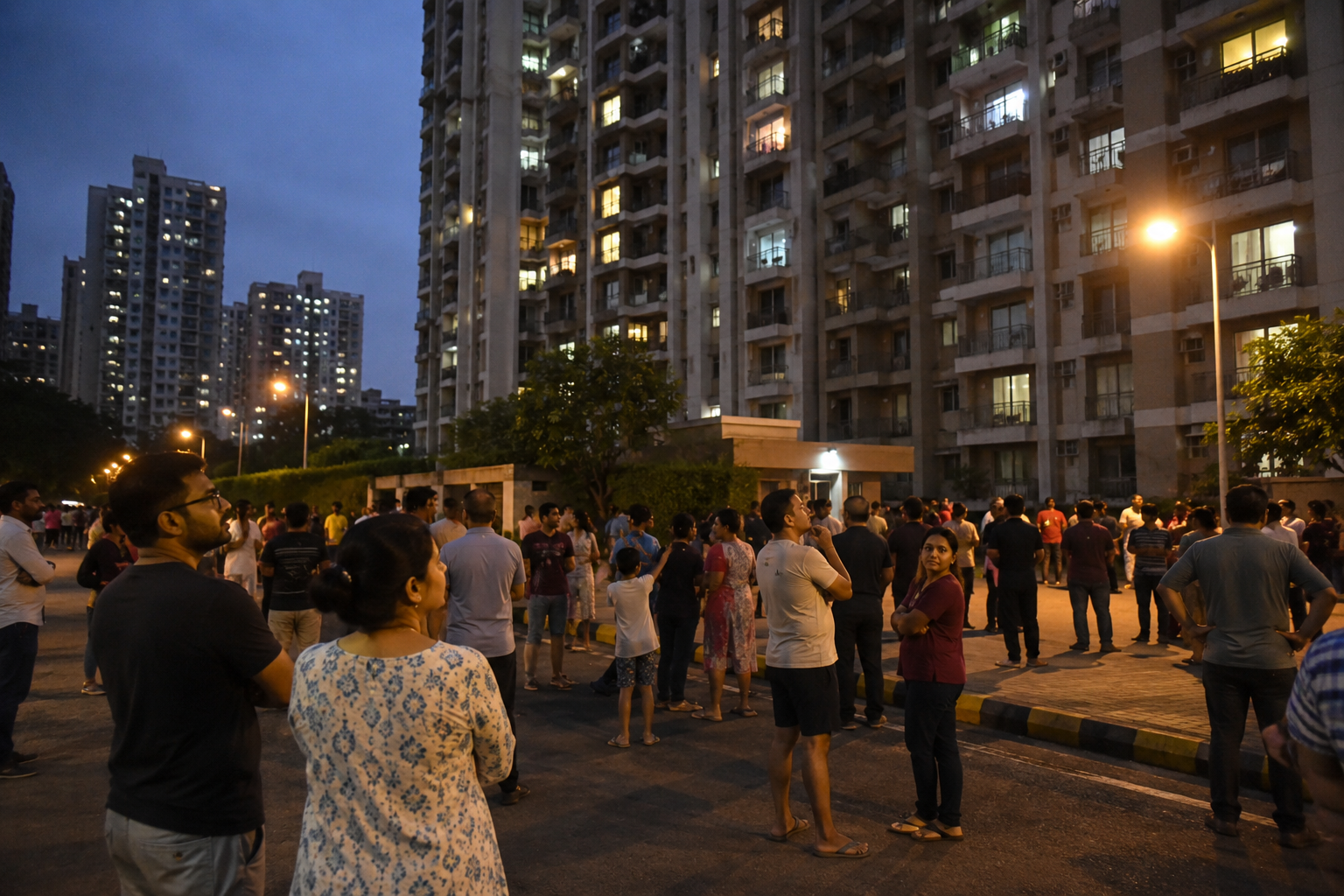
There were no immediate reports of major damage or casualties, but the shaking caused panic as people rushed out of buildings.
The incident again highlights why earthquake awareness is important for high-rise residents and families living in northern India.
Strong Tremors Felt Across North India
Residents in Delhi-NCR, Jammu and Kashmir, and several parts of North India felt earthquake tremors on Saturday evening after a strong quake struck Afghanistan’s Hindu Kush region. The shaking was reported around 7:04 pm IST, causing brief panic in homes, offices, apartments, and public places.
According to the National Centre for Seismology, the earthquake measured magnitude 6.2 and occurred at a depth of 215 km beneath the surface. The epicentre was located in Afghanistan’s Hindu Kush region, a highly active seismic zone known for frequent earthquakes.
People in Delhi-NCR and Srinagar reported feeling sudden shaking, while some residents stepped outside their buildings as a precaution. Reports from news agencies also said tremors were felt in parts of Pakistan, including Islamabad and northern regions. Reuters reported that the European-Mediterranean Seismological Centre measured the quake at magnitude 6.0 and placed it at a depth of 100 km, showing that early measurements can vary slightly between agencies.
As of the initial reports, there were no immediate reports of major damage or casualties. However, the incident created concern because Delhi-NCR has many high-rise apartments, commercial towers, metro corridors, bridges, and dense residential colonies where even brief tremors can trigger fear.
Why Delhi Felt an Earthquake From Afghanistan
Many readers may wonder why an earthquake in Afghanistan was felt so clearly in Delhi and other parts of North India. The answer lies in the combination of earthquake magnitude, depth, and regional geology.
The Hindu Kush region lies near the collision zone of major tectonic plates. Earthquakes from this area can send seismic waves across long distances. When a quake occurs deep underground, its energy can travel widely before weakening. That is why a deep earthquake in Afghanistan can sometimes be felt in Pakistan, Jammu and Kashmir, Punjab, Haryana, Delhi-NCR, and even other northern Indian regions.
This does not mean Delhi was the epicentre. It means the seismic waves travelled far enough for people to feel shaking. A deep earthquake may not always cause severe surface damage near the epicentre, but it can be felt across a wider area.
This is also why earthquake reports often mention three things together: magnitude, location, and depth. Magnitude tells how strong the quake was. Location tells where it started. Depth helps explain how far its shaking may travel and how strongly it may affect nearby or distant areas.
What People Should Do During Tremors
Earthquakes are unpredictable, and panic can sometimes become more dangerous than the tremor itself. The safest response is calm, quick action.
If you are indoors during shaking, do not rush blindly toward stairs or elevators. Move away from windows, mirrors, heavy shelves, glass doors, and objects that may fall. Take cover under a strong table if possible, protect your head and neck, and wait until the shaking stops.
If you are in a high-rise building, avoid using elevators immediately after the tremor. Power supply or lift systems may be affected. Use stairs only when the shaking has stopped and it is safe to move.
If you are outdoors, stay away from buildings, electric poles, boundary walls, trees, and overhead wires. If you are driving, slow down carefully and stop in an open area away from bridges, flyovers, and power lines.
For families, this is also a reminder to keep a small emergency kit ready. It can include drinking water, basic medicines, flashlight, power bank, important documents, baby essentials, and emergency contact numbers. In cities like Delhi-NCR, where many people live in apartments, residents should also know their building’s evacuation route.
The emotional side of such sudden events is also important. Earthquake tremors can create anxiety even when there is no major damage. Readers who want to understand how breathing can support calmness during stress may also explore our guide on Can Rhythmic Breathing Rewire Anxiety? The Science of Sudarshan Kriya.
A Wake-Up Call for Urban Safety
Delhi-NCR has rapidly grown into one of India’s densest urban regions. With high-rise housing societies, office towers, malls, metro systems, and flyovers, earthquake preparedness is no longer a topic only for scientists and disaster-response teams. It is something every household should understand.
Today’s tremors did not bring immediate reports of major damage, but they reminded people that North India remains connected to a broader seismic belt. Even if the epicentre is outside India, the impact can still be felt in Indian cities.
For local administrations, housing societies, schools, offices, and families, the key lesson is preparedness. Buildings should follow safety norms, residents should know what to do during shaking, and emergency communication should be clear.
This also connects with the larger pattern of environmental and disaster-related risks affecting daily life. Readers can also check our earlier coverage on India Heatwave 2026: Why Record Temperatures Are Becoming a Bigger Warning for Everyday Life, where we explained how weather and climate-linked risks are becoming part of everyday public safety discussions.
The Afghanistan earthquake may pass as a short evening scare for many people in Delhi-NCR, but it should not be ignored. It is a reminder that safety awareness matters before disaster strikes, not after.
Source: Economic Times
Read More: Latest News
Read More Interesting Content in My Blog Section of ‘The Thrive Journey’.