








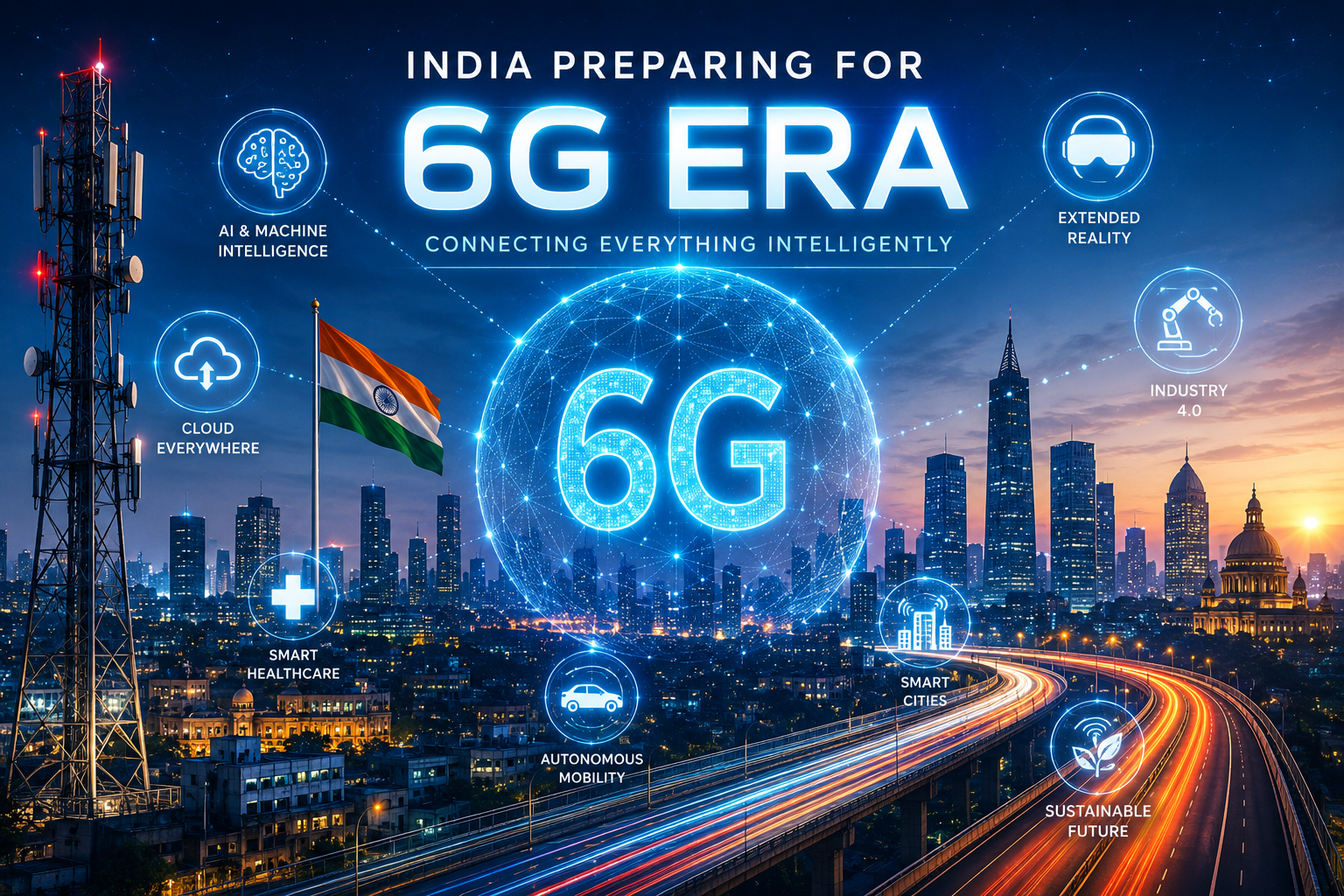
India is preparing for the 6G era through the Bharat 6G Mission, research funding, global collaboration, and indigenous telecom innovation. Unlike 5G, the next generation of connectivity is expected to go beyond faster internet and support AI-driven networks, smart cities, remote healthcare, connected agriculture, immersive education, and advanced industry applications. While commercial rollout is still expected closer to the end of this decade, India is working to become an active contributor rather than just a technology adopter.
India’s digital journey is entering a new phase as the country prepares for the 6G era, a next-generation communication revolution that could reshape how people work, study, travel, access healthcare, and interact with technology. While 5G is still expanding across India, the government, telecom industry, research institutions, and startups are already working on the foundation for 6G through the Bharat 6G Mission and related innovation programs.
The Department of Telecommunications has described the Bharat 6G vision as an effort to design, develop, and deploy 6G network technologies that provide intelligent, secure, and universal connectivity for a better quality of life. The official vision focuses not only on faster internet but also on creating a connected digital ecosystem where machines, people, devices, sensors, and AI-enabled systems can communicate almost instantly.
For ordinary users, this may sound like another technical upgrade. But 6G could be far more transformative than simply downloading videos faster. It may become the invisible digital layer behind smart homes, driver-assistance systems, remote education, precision agriculture, advanced healthcare, and real-time industrial automation.
Why India Is Preparing Early for 6G
India does not want to repeat the earlier pattern of depending heavily on foreign telecom technologies. With 6G, the country is trying to build domestic capability from the beginning. The Bharat 6G Alliance has been created as a collaborative platform involving government, academia, industry, startups, and research institutions to support innovation, standardisation, and indigenous development.
In March 2026, Union Minister Jyotiraditya Scindia said India aims to contribute nearly 10 percent of global 6G patents, with around 4,000 patents already contributed. He also stated that India’s proposal on ubiquitous connectivity has been accepted by international bodies such as 3GPP and the International Telecommunication Union.
This matters because global telecom standards decide how future networks are built. If India contributes to standards, patents, and research early, Indian companies may gain a stronger role in the global 6G economy. The government has also supported research through the Telecom Technology Development Fund, under which 104 projects related to 6G technology worth ₹275.88 crore had been approved till July 31, 2025.
6G Will Be More Than Just Faster Internet
The biggest misunderstanding about 6G is that it will only mean faster mobile data. Speed will certainly improve, but the deeper change may come from intelligence built into the network itself.
6G is expected to combine connectivity with artificial intelligence, sensing, edge computing, satellite networks, and immersive technologies. This means networks may not only transmit data but also understand traffic patterns, predict demand, adjust performance automatically, and support real-time digital services.
For example, a future 6G-enabled hospital may support remote diagnostics with ultra-clear imaging, AI-assisted monitoring, and near-instant communication between doctors and devices. In agriculture, 6G could support connected sensors across farms, helping farmers monitor soil, water, crop health, and weather patterns more accurately. In education, students may attend immersive virtual classrooms where science experiments, historical sites, and engineering models can be experienced in realistic 3D environments.
A broader understanding of how intelligent technologies are already entering daily life can be explored in our detailed guide on Artificial Intelligence Basics Everyone Should Know.
How Everyday Life Could Change
For families, students, workers, and small businesses, 6G could quietly improve many daily experiences. Video calls may become more natural and interruption-free. Online learning platforms may become more immersive. Smart devices may respond faster and communicate better with each other. Public transport systems may use real-time data to reduce congestion. Emergency services may respond faster using connected sensors and AI-supported alerts.
Small businesses could also benefit. A shop owner may use real-time inventory systems, AI-driven customer insights, and secure digital payments with better reliability. Rural entrepreneurs may access cloud-based tools, remote training, telemedicine, and market platforms with stronger connectivity than what is available today.
India’s 6G vision also connects with the broader global shift toward AI-led automation and intelligent systems. We recently covered how this transformation is already affecting jobs and industries in Global AI Job Shake-Up: Tech Giants Cut Roles as Automation Reshapes Workforce in 2026.
Challenges Before 6G Becomes Reality
Despite the excitement, 6G will not arrive overnight. India still needs deeper 5G coverage, stronger fibre networks, affordable devices, spectrum planning, cybersecurity safeguards, and large-scale research investment. Global standards are still being developed, and commercial 6G services are expected closer to the end of this decade rather than immediately.
Cybersecurity will also become more important. As more devices connect to networks, the digital attack surface will expand. The Department of Telecommunications has already highlighted that the growth of 5G and the emergence of 6G will make indigenous security innovation and collaborative research essential for India’s digital future.
Another challenge is digital inclusion. If 6G benefits only large cities, the gap between urban and rural India may widen. For 6G to truly change everyday life, it must support affordable access, rural broadband, local-language services, and practical use cases for agriculture, education, healthcare, and small enterprises.
The Bigger Picture
India’s preparation for 6G shows that the country is no longer waiting for the future to arrive from elsewhere. By investing in research, patents, standards, and indigenous telecom development, India is trying to shape the next phase of the internet revolution.
The real promise of 6G is not just a faster phone connection. It is a smarter digital foundation that could connect homes, farms, hospitals, classrooms, factories, transport systems, and public services in ways that feel seamless. If implemented carefully, 6G could become one of the most important technologies behind India’s next digital leap.
For now, 6G remains a work in progress. But India’s early preparation suggests that the next internet revolution may not be only about speed. It may be about building a more intelligent, inclusive, and connected everyday life.
Source: Department of Telecommunications / PIB — Bharat 6G Mission and India’s 6G roadmap
Read More: Latest News
Read More Interesting Content in My Blog Section of ‘The Thrive Journey’.