









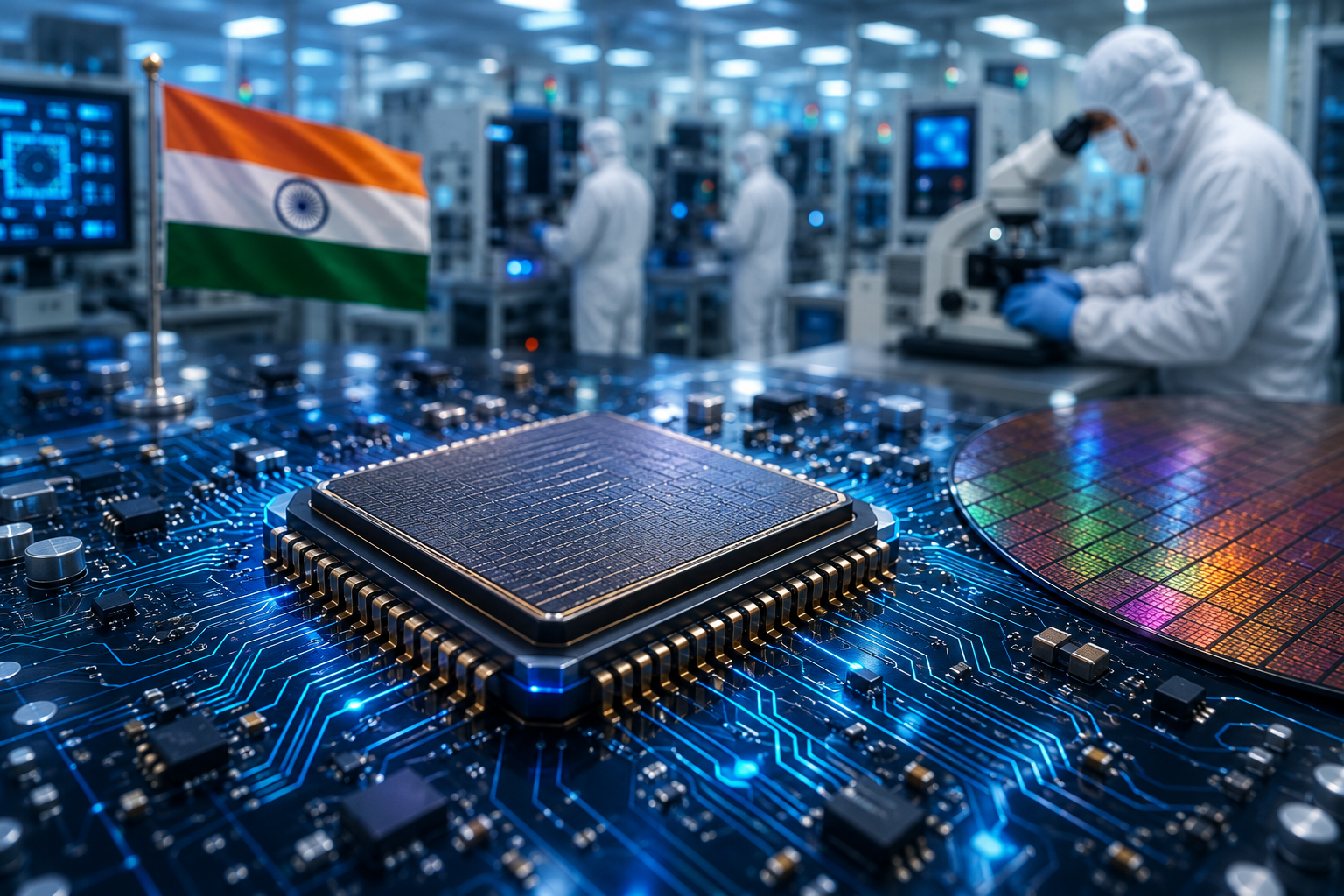
India’s semiconductor mission is gaining fresh momentum as new projects, global partnerships, and domestic manufacturing plans move from announcement to execution. With the government approving more chip-related facilities and major technology players expanding their India presence, the country is trying to reduce dependence on imported chips and build a stronger electronics supply chain. The shift could influence jobs, smartphones, electric vehicles, AI systems, defence electronics, and India’s long-term position in the global technology economy.
India’s semiconductor push is entering a more serious phase as new approvals, global partnerships, and large-scale manufacturing plans begin to strengthen the country’s chip ecosystem. For years, India has been known as a major software and IT services power. Now, the country is trying to build a stronger position in hardware, chip manufacturing, semiconductor design, packaging, and advanced electronics.
The India Semiconductor Mission was launched with a ₹76,000 crore incentive framework to support semiconductor and display manufacturing in the country. The mission aims to reduce India’s dependence on imported chips and create a domestic ecosystem for semiconductor fabrication, design, assembly, testing, and packaging.
This matters because semiconductors are no longer just components hidden inside electronic devices. They are the foundation of modern life. Smartphones, cars, laptops, medical equipment, telecom networks, defence systems, AI servers, electric vehicles, satellites, and even household appliances depend on chips. As global supply chains become more uncertain, countries are racing to secure their own semiconductor capabilities.
India’s Semiconductor Mission Is Moving Beyond Policy
The biggest change in India’s chip journey is that the conversation is slowly moving from policy announcements to real industrial execution. The Union Cabinet approved two more semiconductor manufacturing proposals in Gujarat on May 5, 2026, with a cumulative investment of around ₹3,936 crore and expected employment for 2,230 skilled professionals.
According to recent reporting, India has now approved 12 chip plants under the India Semiconductor Mission, including projects linked to semiconductor manufacturing, display fabrication, compound semiconductors, and assembly-test facilities.
This expansion is important because semiconductor success does not depend on one factory alone. A complete ecosystem needs fabs, packaging units, chemical suppliers, gases, equipment servicing, clean-room infrastructure, skilled engineers, design companies, logistics, and reliable power and water. India is trying to build this ecosystem step by step.
Global Tech Giants Are Looking at India More Seriously
Global interest in India’s semiconductor ecosystem is also increasing. One of the most significant recent developments is the partnership between Tata Electronics and ASML for India’s first front-end semiconductor fabrication plant in Dholera, Gujarat. Reuters reported on May 16, 2026, that ASML, the Dutch chipmaking equipment major, will support Tata Electronics’ 300-mm fab, which is being developed with an estimated $11 billion investment.
This is a strong signal because ASML is one of the world’s most important semiconductor equipment companies. Its involvement indicates that India’s chip ambitions are becoming more connected to the global semiconductor value chain.
Another important development came earlier when Lam Research, a major US-based chip equipment company, announced plans to invest more than $1 billion in India’s Karnataka state over the next few years.
These investments show that global companies are not viewing India only as a consumer market. They are increasingly seeing India as a potential manufacturing, design, talent, and supply-chain hub.
Why Semiconductors Matter for Everyday Indians
For ordinary people, semiconductor manufacturing may sound like a distant industrial topic. But its impact can be very practical. Chips influence the cost, availability, and performance of everyday products such as mobile phones, cars, laptops, smart TVs, routers, medical devices, and digital payment systems.
If India succeeds in developing a stronger semiconductor ecosystem, it could support more stable electronics supply chains and reduce dependence on imports in critical sectors. This does not mean devices will immediately become cheaper, but over time, local capability can improve resilience and support domestic manufacturing.
The semiconductor push is also closely connected to India’s AI future. Artificial intelligence requires advanced chips for training models, running data centres, powering cloud platforms, and enabling smart devices. For readers trying to understand how AI is shaping the future, our detailed guide on The Future of AI: Opportunities and Challenges explains why computing power, data, and responsible innovation are becoming central to modern technology.
Jobs and Skills Could See a Major Shift
India’s semiconductor mission could also create new job opportunities across multiple levels. These jobs may not be limited to chip designers alone. The industry needs process engineers, materials specialists, automation experts, clean-room technicians, equipment maintenance teams, supply-chain managers, quality-control professionals, data analysts, and skilled manufacturing workers.
This is why semiconductor development is also a skills story. India has a large engineering talent base, but chip manufacturing requires specialised training. Universities, technical institutes, and private companies will need to work together to build a workforce ready for semiconductor design, fabrication, packaging, and testing.
The momentum also connects with India’s broader technology transformation. In a recent report, we covered how the Tata–ASML semiconductor deal could push India closer to its first major chip manufacturing breakthrough, especially as global supply chains look for alternatives beyond traditional chip hubs.
Challenges Still Remain
Despite the progress, India’s semiconductor dream will not be easy. Chip manufacturing is one of the most complex industries in the world. It requires huge capital investment, highly controlled clean-room environments, global equipment suppliers, advanced materials, ultra-pure water, uninterrupted power, and years of process learning.
India will also need patience. Semiconductor fabs do not become globally competitive overnight. Countries such as Taiwan, South Korea, Japan, and the United States built their chip ecosystems over decades. India is entering the race at a time when demand for AI chips, automotive chips, power electronics, and advanced packaging is rising quickly, but competition is also intense.
Another challenge is moving beyond assembly and packaging toward deeper manufacturing and design leadership. While assembly and testing are important first steps, long-term strength will require India to build capabilities in chip design, advanced materials, fabrication technologies, equipment maintenance, and intellectual property.
The Bigger Picture
India’s semiconductor mission is not just an industrial policy. It is a long-term strategic move. Chips are now linked to national security, economic resilience, digital infrastructure, AI leadership, clean energy, electric mobility, and global competitiveness.
The latest approvals and global partnerships suggest that India’s semiconductor plans are gaining credibility. The road ahead is still difficult, but the direction is clear: India wants to become more than a software powerhouse. It wants to play a serious role in the hardware backbone of the digital world.
If the current momentum continues, India’s chip ecosystem could become one of the most important pillars of the country’s next technology decade.
Source: Press Information Bureau — Cabinet approves two more semiconductor manufacturing proposals
Read More: Latest News
Read More Interesting Content in My Blog Section of ‘The Thrive Journey’.