








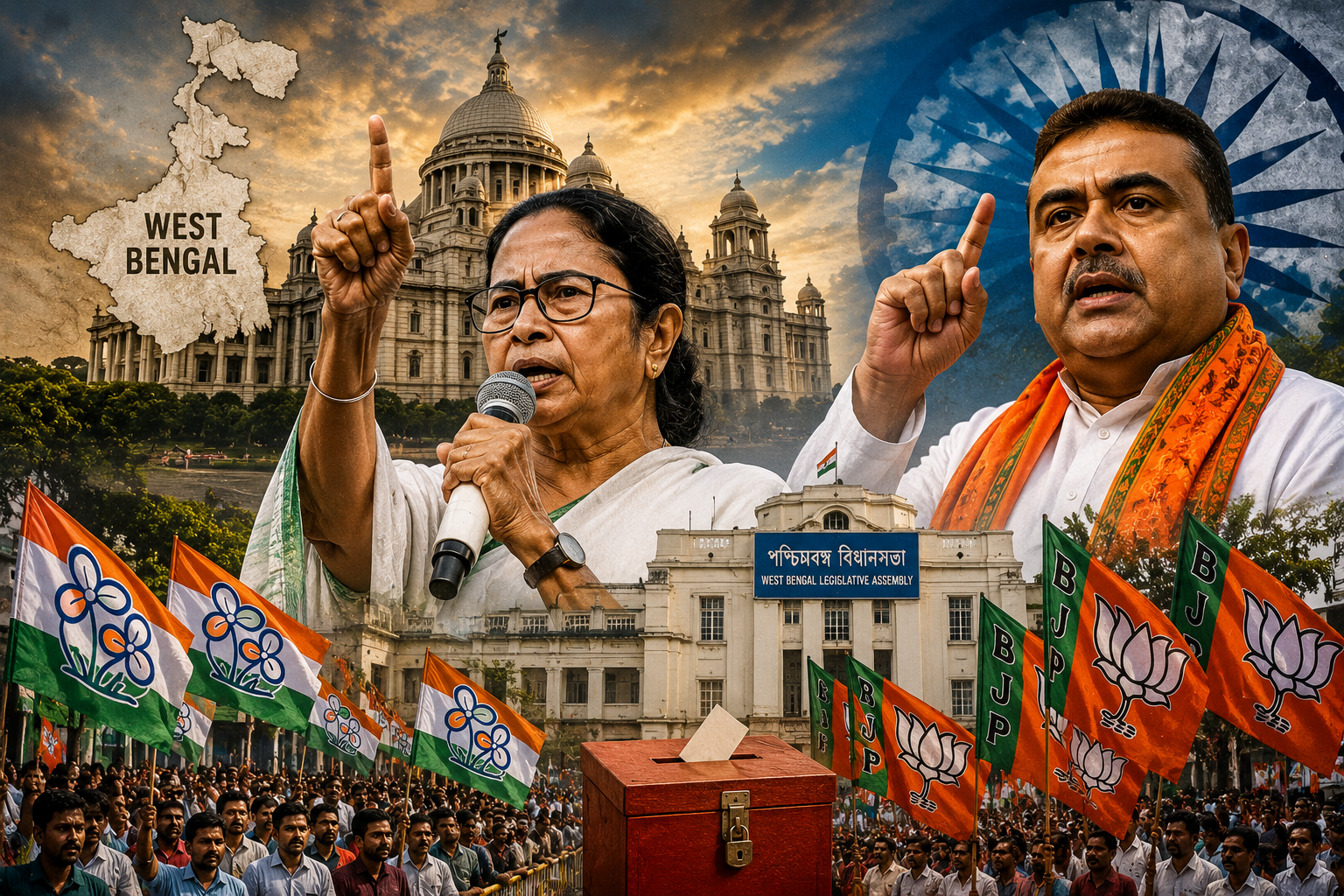
West Bengal politics has entered a dramatic new phase after the 2026 Assembly election results triggered a major political reset in the state. The BJP’s strong performance, TMC’s sharp allegations, Mamata Banerjee’s refusal to accept the outcome quietly, and Suvendu Adhikari’s growing role have turned Bengal into one of India’s most closely watched political battlegrounds.
According to NDTV’s election result coverage, Mamata Banerjee alleged that the Election Commission played a “nasty game” against her party after the results and said she would not resign from the chief minister’s post at that time. The report reflected the tense political mood after TMC suffered a major setback in the state.
West Bengal politics has always been intense, emotional, and highly competitive. But after the 2026 Assembly election results, the state appears to have entered a completely new political chapter. The election did not simply change numbers in the Assembly. It changed the tone of Bengal’s politics, the confidence of the BJP, the strategy of the Trinamool Congress, and the future direction of governance in the state.
The BJP’s strong performance has shaken a political landscape that was dominated by Mamata Banerjee and TMC for more than a decade. Economic Times reported that BJP crossed the majority mark comfortably and reached 206 seats, while TMC was trailing at 81 seats. The same report also noted that Suvendu Adhikari won from Bhabanipur against Mamata Banerjee by more than 15,000 votes and also won from Nandigram.
These numbers explain why the result is being seen as a turning point. Bengal is not just another state in Indian politics. It carries deep ideological, cultural, regional, and national significance.
Mamata Banerjee’s Response Keeps the Political Temperature High
After the results, Mamata Banerjee did not step back quietly. NDTV reported that she accused the Election Commission of playing “nasty games” against her party and said that she would not resign from the chief minister’s post.
This response shows that TMC is not treating the result as a normal electoral defeat. Instead, the party is trying to frame the outcome as controversial and politically contested. This could keep Bengal politics heated for months because TMC still has a strong organisation, loyal voter base, and emotional connection with many sections of the electorate.
Mamata Banerjee has built her political career on resistance. Whether against the Left Front earlier or the BJP in recent years, her image has often been shaped by confrontation. Even after a major setback, she may attempt to rebuild TMC through street politics, legal challenges, public campaigns, and organisational restructuring.
Suvendu Adhikari Becomes Central to Bengal’s New Story
One of the biggest political figures after the 2026 election is Suvendu Adhikari. His victory in Bhabanipur against Mamata Banerjee has given him major symbolic power. Economic Times reported that Adhikari defeated Mamata Banerjee in Bhabanipur by 15,105 votes and also won from Nandigram.
Times of India later reported that Adhikari resigned from the Nandigram assembly seat and chose to retain Bhabanipur, while saying he would not leave Nandigram emotionally or politically. The report said he had defeated TMC’s Pabitra Kar in Nandigram by 9,665 votes and had achieved a bigger win in Bhabanipur.
This is politically important because Bhabanipur has long been associated with Mamata Banerjee’s political identity. A victory there is not just a seat-level result; it carries symbolic weight across Bengal.
Adhikari’s decision to retain Bhabanipur also sends a message that BJP wants to challenge TMC directly in its strongest symbolic spaces.
Minority Vote Split Changed the Political Map
One of the most discussed aspects of the election has been the shift in voting patterns. Times of India reported that a split in minority votes helped BJP breach several TMC strongholds, including Muslim-majority and Muslim-influenced constituencies that had earlier been seen as part of Mamata Banerjee’s strong support base.
This point is extremely important for understanding Bengal’s political change. TMC’s earlier electoral strength was built through a broad coalition involving women voters, rural voters, minorities, welfare beneficiaries, and anti-BJP voters. If that coalition weakens, the entire political equation changes.
A minority vote split does not only help BJP numerically. It also changes political confidence. Constituencies that were earlier considered difficult for BJP may now become competitive. This can affect future municipal elections, Lok Sabha strategies, and long-term party organisation.
Delimitation and Assembly Reorganisation Could Become the Next Flashpoint
The political battle may not end with the election result. Times of India reported that Suvendu Adhikari has hinted at a possible reorganisation of assembly segments and even the need for a larger assembly building after a planned delimitation exercise based on updated census data.
Delimitation can become a major political issue because redrawing constituency boundaries can affect electoral calculations. Parties may gain or lose advantage depending on how population changes are reflected in new seats or boundaries.
For Bengal, this could become highly sensitive. The state has complex regional, religious, linguistic, rural, and urban voter patterns. Any change in constituency boundaries may trigger debate over representation, fairness, local identity, and political advantage.
This means Bengal politics may remain intense even after government formation, because the next battle could move from elections to boundaries, governance, law and order, welfare schemes, and political legitimacy.
Why Bengal Matters Nationally
West Bengal is not just important for state politics. It is also important for national politics. A major BJP breakthrough in Bengal would strengthen the party’s eastern India footprint and reshape opposition politics. For TMC, losing Bengal would be a major national setback because the party’s identity and strength are deeply tied to the state.
This political shift may also influence future alliances. Opposition parties may reassess TMC’s role at the national level. BJP may present Bengal as proof of expanding influence beyond its traditional strongholds. Regional parties may study whether welfare-heavy politics alone is enough against a strong national campaign.
For readers who follow national political shifts, our earlier coverage of India’s global and strategic direction gives wider context on how domestic politics connects with national positioning.
On our parent website, readers can also explore broader social and civic themes through our main content categories:
Bengal Enters a New Political Era
The 2026 Bengal election has created a new power equation. BJP is no longer only a challenger; it has become the central force in the state’s new political story. TMC, despite its setback, remains emotionally and organisationally significant. Mamata Banerjee’s reaction shows that the party will not disappear quietly.
The coming months may bring protests, legal moves, administrative changes, internal party reshuffles, and fresh political narratives. Suvendu Adhikari’s role will remain closely watched, especially after his symbolic victory in Bhabanipur and his decision to retain that seat.
Bengal politics has always carried drama, ideology, street power, and strong personalities. After the 2026 result, that intensity has only increased.
The election may be over, but Bengal’s real political battle appears to have just entered its next phase.
Source: NDTV Bengal Election Results Coverage
Read More: Latest News
Read More Interesting Content in My Blog Section of ‘The Thrive Journey’.