








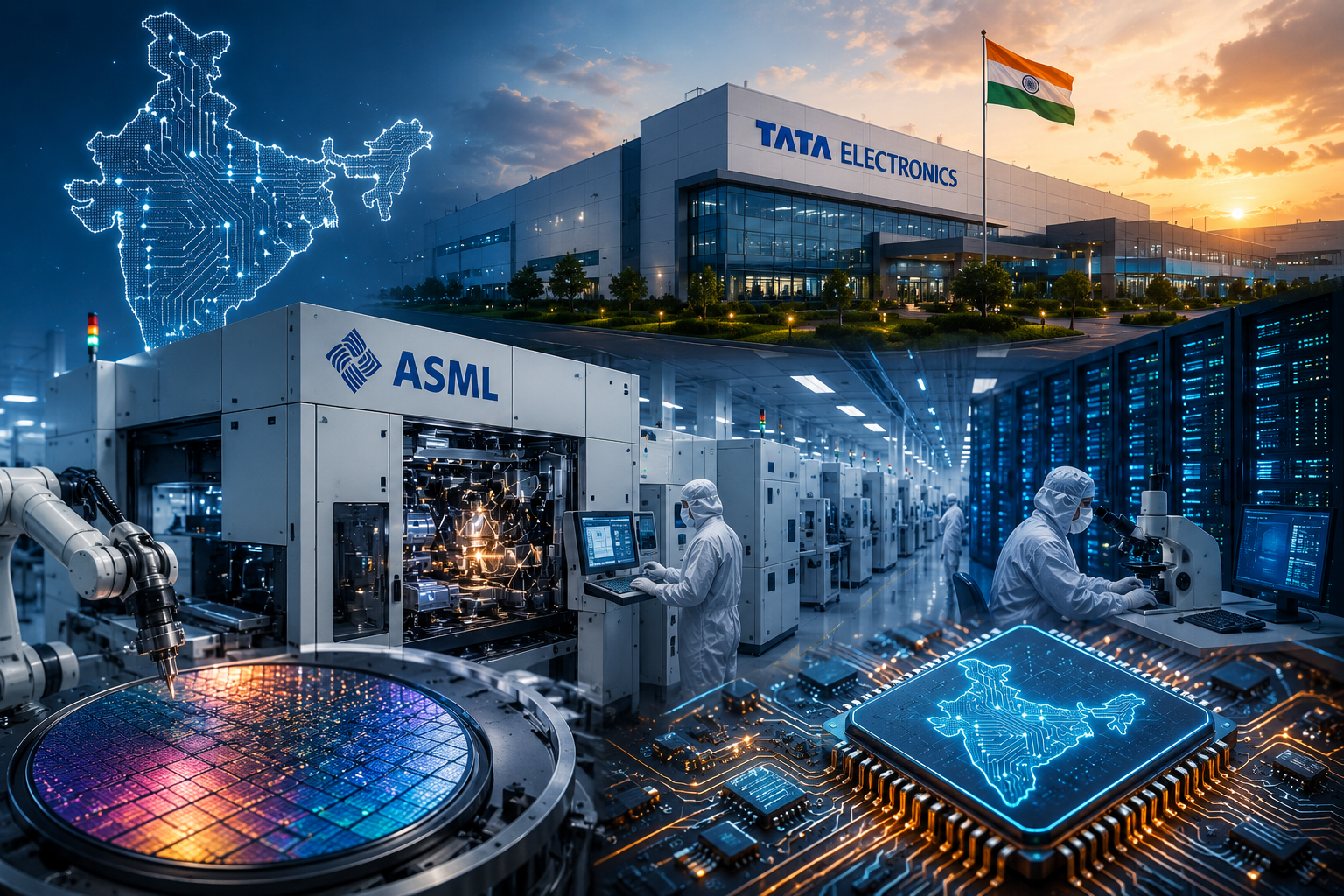
India’s semiconductor dream has received a major boost as Tata Electronics and Dutch technology giant ASML have signed an agreement linked to India’s first front-end semiconductor fabrication plant in Gujarat. The deal was announced during Prime Minister Narendra Modi’s visit to the Netherlands, where India and Dutch companies discussed deeper cooperation in semiconductors, artificial intelligence, clean energy, ports, and advanced manufacturing.
According to Reuters, Tata Electronics and ASML have partnered on India’s first semiconductor fab, with the agreement signed in the presence of Prime Minister Narendra Modi and Dutch Prime Minister Rob Jetten. The project is part of India’s wider push to build domestic semiconductor manufacturing capacity and reduce dependence on foreign chip supply chains.
India’s ambition to become a global semiconductor manufacturing hub has taken another important step forward. Tata Electronics and ASML, one of the world’s most important semiconductor equipment companies, have signed an agreement linked to India’s first front-end semiconductor fabrication plant in Gujarat. This development could become a major milestone for India’s technology, electronics, manufacturing, and digital infrastructure future.
Semiconductors are the tiny chips that power almost every modern device. They are used in smartphones, laptops, cars, defence systems, satellites, medical equipment, artificial intelligence servers, telecom networks, and industrial machines. Without semiconductors, the modern digital economy cannot function.
For years, India has been a major consumer of chips but not a major manufacturer of advanced semiconductors. Most high-end chip manufacturing has been concentrated in countries such as Taiwan, South Korea, the United States, Japan, and parts of Europe. This created a strategic weakness for India because the country depends heavily on imports for electronics and high-tech products.
Now, the Tata–ASML partnership signals that India is moving from ambition to execution.
Why ASML’s Role Matters
ASML is not an ordinary technology company. It is one of the most critical companies in the global semiconductor industry because it makes highly advanced lithography machines used to manufacture chips. Lithography is the process of printing extremely tiny circuit patterns on silicon wafers. Without such machines, advanced chip production is impossible.
That is why ASML’s involvement is important for India. Even if India builds semiconductor plants, it needs world-class equipment, process expertise, technology partnerships, engineering talent, supply-chain support, and long-term industrial planning.
Reuters reported that Tata Electronics and ASML signed an agreement for India’s first front-end semiconductor fabrication plant in Gujarat. The report also said the deal was signed during PM Modi’s Netherlands visit, where Indian and Dutch leaders engaged with CEOs from major companies in technology, energy, and ports.
This shows that India’s semiconductor push is not happening in isolation. It is being connected with global partnerships, diplomatic engagement, and industrial cooperation.
Gujarat Could Become a Major Chip Manufacturing Base
The semiconductor fab linked to Tata Electronics is expected to be located in Gujarat, a state that has already attracted major interest in electronics, manufacturing, renewable energy, and industrial infrastructure. Reuters noted that the wider semiconductor push includes a Tata Electronics facility in Gujarat and forms part of India’s broader initiative backed by billions in subsidies.
A front-end semiconductor fab is especially important because it deals with the actual chip manufacturing process on wafers. This is different from only assembling, testing, or packaging chips. Front-end fabrication is much more complex and requires extremely clean facilities, precision equipment, uninterrupted utilities, skilled engineers, and stable supply chains.
If India succeeds in building and scaling such facilities, it could reduce import dependence, attract global electronics companies, create high-skilled jobs, and strengthen India’s position in the global technology economy.
For readers who follow India’s technology rise, this development connects naturally with the broader transformation happening in AI, electronics, automation, and digital infrastructure. On our parent website, we have explained the basics and future impact of artificial intelligence in detail here.
Semiconductor Supply Chains Are Now Strategic
The world learned the importance of chips during the global semiconductor shortage. Car companies slowed production, electronics prices were affected, and countries realized that chip supply chains were not just a business issue. They had become a national security and economic stability issue.
Today, semiconductors are linked with defence, artificial intelligence, electric vehicles, renewable energy systems, telecom networks, and advanced computing. Countries that control chip supply chains gain economic and strategic strength.
This is why India is trying to build its own semiconductor ecosystem. The goal is not only to produce chips but to create a full value chain involving design, fabrication, assembly, testing, packaging, equipment, materials, research, and talent development.
The Tata–ASML agreement is important because it places India closer to the difficult manufacturing side of the semiconductor industry. It also supports the government’s long-term vision of making India a reliable alternative in global supply chains.
AI Growth Makes Chip Manufacturing Even More Important
The rise of artificial intelligence has made semiconductors even more valuable. AI models need powerful chips, servers, data centers, and high-performance computing systems. As more countries and companies invest in AI, demand for advanced chips is rising.
This means India’s semiconductor strategy is also an AI strategy. If India wants to become a serious player in artificial intelligence, cloud computing, automation, robotics, defence technology, and digital infrastructure, it needs stronger access to chips.
During the Netherlands visit, PM Modi also pushed for deeper India-Netherlands collaboration in AI, chips, and clean energy, according to The Economic Times. The report said Modi highlighted resilient supply chains and future-focused sectors such as artificial intelligence and semiconductors during the visit.
This shows that India is trying to connect multiple future industries together: chips for AI, AI for digital services, clean energy for industrial growth, and global partnerships for supply-chain resilience.
This topic also connects with our recent news coverage on AI and digital infrastructure risks, especially as global tech systems become increasingly dependent on advanced computing.
What This Means for Jobs and Indian Industry
If India’s semiconductor projects succeed, the impact could go far beyond one factory. It could create jobs for engineers, technicians, researchers, plant operators, software professionals, supply-chain managers, logistics companies, and equipment-service providers.
It could also benefit Indian universities and technical institutes. Semiconductor manufacturing requires expertise in electronics, physics, materials science, mechanical systems, chemical processing, automation, clean-room management, and data-driven quality control.
A strong semiconductor ecosystem could also support startups in chip design, embedded systems, electric vehicles, drones, medical electronics, defence systems, and industrial IoT.
However, the challenge is not small. Semiconductor manufacturing is expensive, complex, and highly competitive. India will need reliable power, water, skilled manpower, global suppliers, stable policy support, and long-term patience. A fab cannot become successful overnight. It requires years of execution, learning, and scale-building.
India’s Chip Moment Is Becoming More Serious
The Tata–ASML agreement is not just another corporate announcement. It is a signal that India’s semiconductor mission is becoming more serious and more globally connected.
For India, the opportunity is huge. The country has a large domestic electronics market, strong software talent, growing manufacturing ambitions, and government support. But to become a true semiconductor power, India must build trust with global technology partners and prove that it can execute complex projects at international standards.
The Netherlands partnership is important because Dutch companies play a major role in global high-tech manufacturing. If India can deepen cooperation with such partners, it can accelerate its learning curve.
The coming years will decide whether India can move from chip ambition to chip production at scale. The Tata–ASML deal is a promising step, but the real success will depend on execution, technology transfer, talent development, and supply-chain depth.
Still, this is one of the strongest signals yet that India is preparing for a future where semiconductors, AI, clean energy, and advanced manufacturing will decide national competitiveness.
Source: Reuters
Read More: Latest News
Read More Interesting Content in My Blog Section of ‘The Thrive Journey’.