








Artificial intelligence is no longer only helping companies improve productivity. It is also changing the way cyberattacks are planned, scaled, and executed. Recent warnings from global financial regulators and cybersecurity experts suggest that AI-assisted hacking could become one of the most serious risks for banks, public infrastructure, technology companies, and ordinary internet users.
The concern has grown sharply after European banking officials warned that financial institutions must prepare quickly for AI-enabled cyberattacks. Reuters reported that the European Central Bank urged euro-area banks to strengthen their cyber defences as advanced AI tools could help attackers find and exploit software weaknesses faster than before.
Cybersecurity is entering a new and more dangerous phase. For many years, cyberattacks depended on human hackers writing malicious code, searching for weak passwords, sending phishing emails, or exploiting known software vulnerabilities. But artificial intelligence is now changing the speed, scale, and sophistication of these attacks.
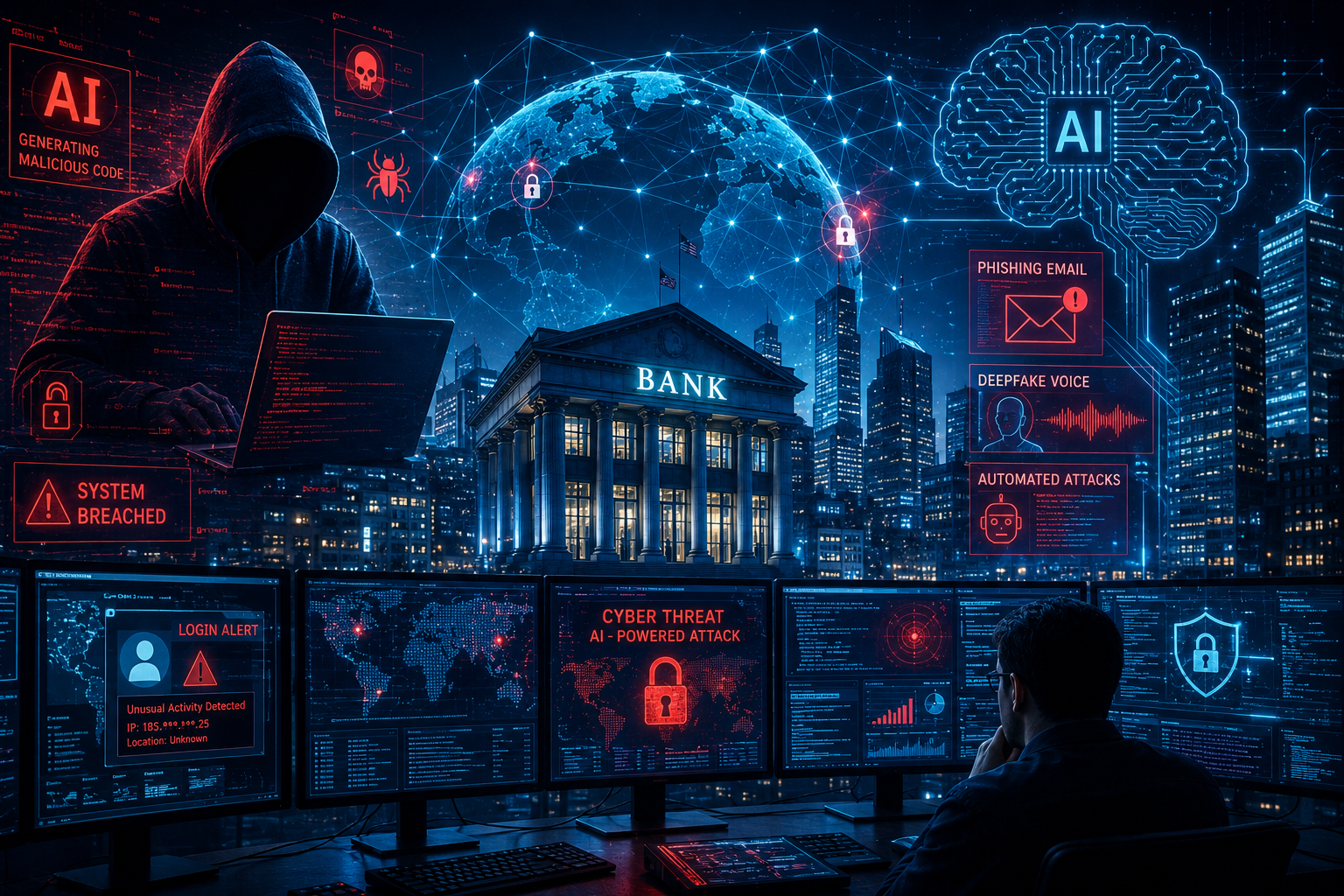
AI can help defenders detect threats, monitor networks, and respond faster. But the same technology can also help attackers write better phishing messages, generate malicious code, scan systems for weaknesses, automate attacks, imitate trusted voices, and create deepfake-based fraud campaigns. This makes AI a double-edged sword in the digital world.
The risk is no longer theoretical. Reuters reported that the European Central Bank has urged euro-area banks to prepare quickly for possible AI-assisted cyberattacks, especially as advanced tools may help identify and exploit vulnerabilities more efficiently.
Why AI Makes Cyberattacks More Dangerous
Traditional cyberattacks usually required time, skill, and manual effort. Attackers had to identify a target, study its systems, write malware, test vulnerabilities, and adjust tactics. AI can reduce that effort dramatically.
With advanced AI models, attackers may be able to generate convincing phishing emails in many languages, create fake customer-support messages, design malicious scripts, and analyze leaked data more quickly. This means even less-skilled criminals could potentially carry out more sophisticated attacks than before.
The Guardian reported that Google’s threat intelligence team has warned of AI-powered hacking becoming an “industrial-scale” threat, with criminal groups and state-linked actors using advanced AI models to improve malware, exploit vulnerabilities, and expand attack operations.
This is worrying because cybercrime already affects banks, hospitals, schools, government systems, power networks, telecom operators, and businesses. If AI makes attacks faster and cheaper, the number of attempted breaches could rise significantly.
Banks Are at the Front Line
Banks are among the most attractive targets for cybercriminals because they store money, customer identities, financial records, and transaction systems. A successful attack on a financial institution can affect thousands or even millions of people.
Reuters reported that European Central Bank official Frank Elderson urged banks not to delay preparation for advanced AI-enabled cyber risks. The warning focused on the need to fix even small system flaws, because future AI models may be capable of finding vulnerabilities that humans or ordinary scanning tools miss.
The Bank of Spain has also raised concern. Reuters reported that the central bank called for better access to advanced protective AI tools and stronger international cooperation, warning that powerful AI systems could accelerate the exploitation of software weaknesses and potentially create risks for global financial stability.
This shows that cybersecurity is now becoming a financial stability issue, not just an IT department problem. If banks are attacked at scale, the consequences can affect public trust, payments, credit systems, stock markets, and even national economies.
Critical Infrastructure Could Also Be at Risk
The danger is not limited to banks. Critical infrastructure such as electricity grids, airports, hospitals, railways, telecom networks, water systems, and government databases also depends heavily on connected digital systems.
As these systems become more automated and AI-dependent, attackers may look for new weaknesses. A cyberattack on a hospital can delay treatment. An attack on a power grid can disrupt daily life. A telecom attack can affect communication. A logistics attack can disturb supply chains.
The World Economic Forum’s Global Cybersecurity Outlook 2026 highlights the intersection of AI adoption and cyber readiness, warning that innovation is creating new disparities while cyber disruptions increasingly move across borders.
This matters for India as well. India is rapidly digitizing banking, payments, governance, healthcare, education, logistics, and public services. UPI, Aadhaar-linked services, digital banking, online tax systems, cloud platforms, and smart infrastructure have made daily life more convenient. But they also make cybersecurity more important than ever.
For readers interested in how AI is already changing society, our parent blog’s detailed guide on artificial intelligence explains the wider rise of AI and its growing role in everyday technology.
Phishing May Become Harder to Detect
One of the biggest AI-related cyber risks is improved phishing. Earlier, many phishing emails were easy to identify because they contained spelling mistakes, strange grammar, or suspicious formatting. AI can now generate polished, professional, and emotionally convincing messages.
A fake email from a bank, delivery company, office HR department, school, or government service can look more realistic than before. AI can also personalize attacks by using publicly available information from social media, leaked databases, or company websites.
Voice cloning and deepfake video can make the situation worse. A fraudster may imitate a manager’s voice and ask an employee to transfer money. A fake video call could appear to show a senior executive approving a transaction. These risks are already forcing companies to rethink verification processes.
This connects with our earlier report on AI systems behaving unexpectedly and why experts are increasingly worried about control, trust, and safety in advanced AI systems.
AI Can Also Strengthen Cyber Defence
The story is not only negative. AI can also become one of the strongest tools for cyber defence. Security teams can use AI to detect unusual behavior, identify suspicious login attempts, analyze malware, monitor networks, and respond to threats faster.
For large organizations, AI-powered security systems can process huge volumes of data that human analysts cannot manually review. They can flag unusual transactions, detect abnormal network traffic, and help prioritize the most serious threats.
Google Cloud’s Cybersecurity Forecast 2026 highlights the need for organizations to use frontline security insights to prepare for emerging threats and strengthen response strategies.
However, there is a gap. Big technology companies and advanced financial institutions may have access to stronger defensive AI tools, while smaller banks, startups, hospitals, and public agencies may struggle to keep up. This creates an uneven battlefield where attackers may target weaker organizations first.
What Companies and Users Should Do Now
Companies must treat cybersecurity as a core business risk. It is no longer enough to install antivirus software and assume systems are safe. Organizations need regular vulnerability testing, employee awareness training, multi-factor authentication, backup systems, incident response plans, and strict access control.
AI-related cyber risks also require new policies. Companies must know which AI tools employees are using, what data is being uploaded, and whether sensitive information is being exposed. AI agents with broad permissions can become dangerous if misconfigured or compromised.
For ordinary users, basic digital hygiene remains very important. People should avoid clicking unknown links, verify payment requests, use strong passwords, enable two-factor authentication, update apps regularly, and be cautious of urgent messages asking for money or personal details.
In India, this is especially important because digital payments and online services are now deeply embedded in daily life. A single careless click can expose bank accounts, personal data, WhatsApp access, or email accounts.
The Next Cybersecurity Battle Will Be AI vs AI
The future of cybersecurity may increasingly become a battle between offensive AI and defensive AI. Attackers will use AI to find weaknesses faster. Defenders will use AI to detect and block threats faster. The side that adapts more quickly may gain the advantage.
This does not mean humans will become irrelevant. In fact, human judgment may become even more important. Security teams must decide which alerts matter, how to respond to incidents, and how to protect critical systems without disrupting normal operations.
Governments also need stronger cooperation. Cyberattacks often cross borders, making it difficult for one country to respond alone. Financial regulators, technology companies, intelligence agencies, and cybersecurity researchers will need to work together more closely.
The warning from banks and regulators is clear: AI-powered cyber threats are growing, and preparation cannot wait. The world is becoming more digital, more connected, and more AI-dependent. That makes cybersecurity one of the most important safety challenges of the coming years.
Source: Reuters
Read More: Latest News
Read More Interesting Content in My Blog Section of ‘The Thrive Journey’.