




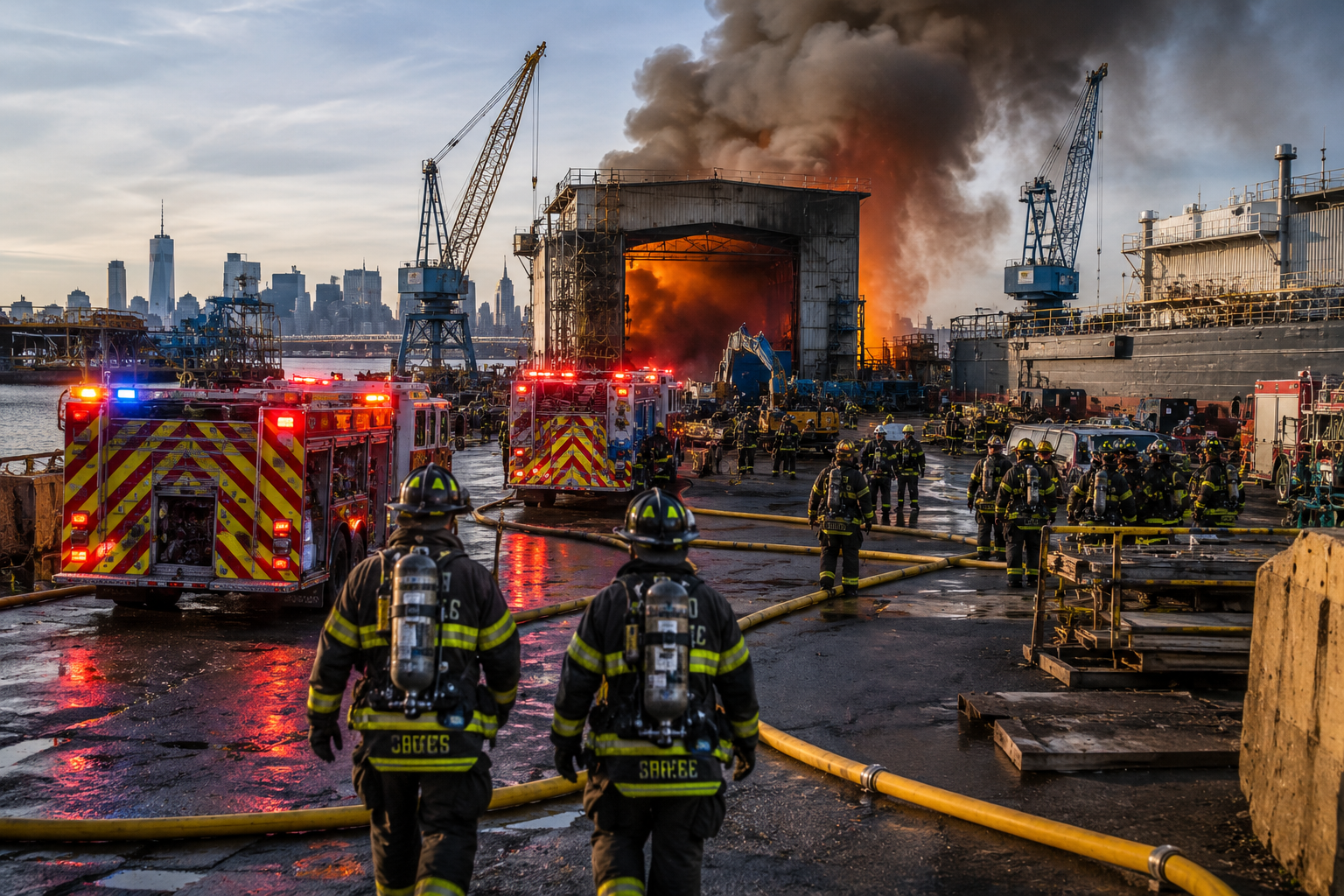
A fire and explosion at a New York City shipyard on Staten Island has left one person dead and 36 others injured, including firefighters and emergency responders. Officials said the incident began inside a large metal structure at the site, where rescue crews were responding to reports of people trapped. A second explosion later injured more responders, turning the shipyard fire into one of the most serious emergency incidents in the city this week.
A deadly fire and explosion at a New York City shipyard has raised fresh concerns about industrial safety, emergency response risks, and the dangers firefighters face during complex rescue operations. The incident happened on Staten Island, where a fire inside a large metal structure triggered explosions that killed one civilian and injured 36 people, many of them first responders.
According to the Associated Press, the emergency unfolded on Friday afternoon at a shipyard in New York City. Firefighters reached the scene within minutes after reports of a fire in a 150-by-150-foot metal structure. Officials said two workers were believed to be trapped in the basement when emergency crews arrived. During the rescue effort, an explosion injured multiple firefighters and responders. A second explosion later seriously injured a fire marshal and a firefighter who were inside the structure.
The fire marshal was reported to be in critical but stable condition after suffering a fractured skull and brain bleed, while the firefighter’s condition later improved. More than 200 firefighters and emergency personnel responded to the scene as crews worked through the fire, smoke, blast risk, and rescue challenges.
What Happened at the Staten Island Shipyard?
The incident began as a fire emergency but quickly became far more dangerous after explosions occurred during the response. Reports said the fire broke out inside a large metal structure at the shipyard, where workers were initially believed to be trapped. Firefighters entered the dangerous area as part of the rescue operation, but the first blast caused several injuries among responders.
A second explosion made the situation even more serious. Officials said the second blast injured a fire marshal and a firefighter, both of whom were inside the structure at the time. The number of injured later rose to 36, including firefighters, paramedics, and other emergency personnel.
The site reportedly has a long industrial history and was once connected to wartime shipbuilding activity. Today, the area hosts several businesses, which can make emergency response more difficult because older industrial locations may include complex layouts, storage areas, metal structures, electrical systems, fuel sources, and confined spaces.
Why This Explosion Became So Dangerous
Shipyards and dry docks are high-risk environments because they often include heavy machinery, metal structures, welding equipment, fuel systems, confined workspaces, electrical equipment, and stored materials. When a fire starts in such an environment, responders may face hidden hazards that are not immediately visible from outside.
In this case, firefighters were not only battling flames but also trying to rescue people believed to be trapped. That made the emergency more urgent and more dangerous. Rescue crews often have to move quickly during trapped-person calls, but industrial fires can shift rapidly if gases, chemicals, fuel, or pressure-related hazards are involved.
The Associated Press reported that more than 200 firefighters remained on the scene late into the night as the fire was brought under control. The final cause of the explosions is still under investigation.
This is what makes the case important for US readers beyond New York. Industrial emergency response is not like a normal building fire. Responders may not know exactly what is burning, what materials are stored inside, or whether the structure is stable. Every minute can bring a new risk.
Firefighters and First Responders Face the Highest Risk
One of the most emotional parts of this incident is that many of the injured were firefighters and emergency workers. These are the people who enter dangerous spaces while others are being evacuated. When explosions happen during rescue operations, responders can be hit by blast pressure, falling debris, burns, smoke inhalation, or structural collapse.
Reports said several firefighters and paramedics were injured, and two responders suffered serious injuries. People reported that one fire marshal sustained a temporal fracture and brain bleed and was listed in critical but stable condition. Another firefighter who was seriously injured was later stable and under observation.
This incident is a reminder that emergency response is not only about fire trucks arriving at a scene. It requires training, coordination, risk assessment, protective equipment, communication, and fast decision-making under extreme pressure.
For readers who follow technology, infrastructure, and human safety stories, this connects with the larger question of how modern systems prepare for high-risk events. Our earlier report on AI-Powered Cyberattacks Becoming a Bigger Global Risk as Banks and Tech Systems Rush to Prepare shows how risk management is becoming central in both digital and physical systems. Whether the threat is cyber-related or industrial, preparation can decide how much damage a crisis causes.
What Officials Are Investigating Now
The most important question now is what caused the fire and explosions. Investigators will likely examine whether the blast was linked to stored materials, fuel, gases, equipment failure, electrical faults, welding activity, or another industrial hazard. Officials may also review whether safety procedures were followed at the site.
Investigations after such incidents can take time because authorities need to inspect the scene carefully, interview witnesses, examine damaged equipment, review business operations, and reconstruct the timeline. They may also need to determine whether any workplace safety rules were violated.
The public will also want clarity on whether the site had proper fire-safety systems, whether hazardous materials were present, and whether responders had full information before entering the structure.
This matters because industrial zones are not isolated from daily life. Many shipyards, warehouses, factories, and logistics centers operate near homes, roads, businesses, and waterfront areas. A serious explosion can affect workers, emergency responders, nearby residents, and local traffic.
Why US Readers Should Pay Attention
This New York City shipyard explosion is not only a local tragedy. It is a warning about the hidden risks inside America’s industrial infrastructure. Across the United States, many old industrial sites continue to operate while also serving new business purposes. These spaces can be valuable for local economies, but they also require strong safety inspections and emergency planning.
For workers, the incident highlights the importance of industrial safety training, emergency exits, communication systems, and hazard reporting. For cities, it shows why fire departments need updated information about high-risk industrial sites. For families, it is a reminder that public safety depends on systems most people rarely see until an emergency happens.
On The Thrive Journey, we have also explained how small repeated actions shape long-term outcomes in The Science of Habit Formation. Safety works in the same way. Regular inspections, equipment checks, emergency drills, and staff training may look routine, but they can prevent major disasters.
What Happens Next?
The next phase will focus on investigation, recovery, and accountability. Authorities will need to confirm the exact cause of the fire and explosions, identify whether safety failures occurred, and decide whether any enforcement action is needed. The injured responders will also remain a major focus as officials and the public follow their recovery.
For New York City, this incident is a painful reminder of the danger first responders face every day. A fire call can become an explosion scene within minutes. A rescue mission can turn into a mass-casualty emergency. And an industrial workplace can become a public-safety crisis if the risks are not controlled.
For now, the confirmed picture is serious: one person has died, 36 people have been injured, and a full investigation is underway. The Staten Island shipyard explosion will likely remain in the news as officials release more details about the cause, safety conditions, and the recovery of injured firefighters and emergency workers.
Source: New York City shipyard blast kills one and injures 36 people
Read More: Latest News
Read More Interesting Content in My Blog Section of ‘The Thrive Journey’.