








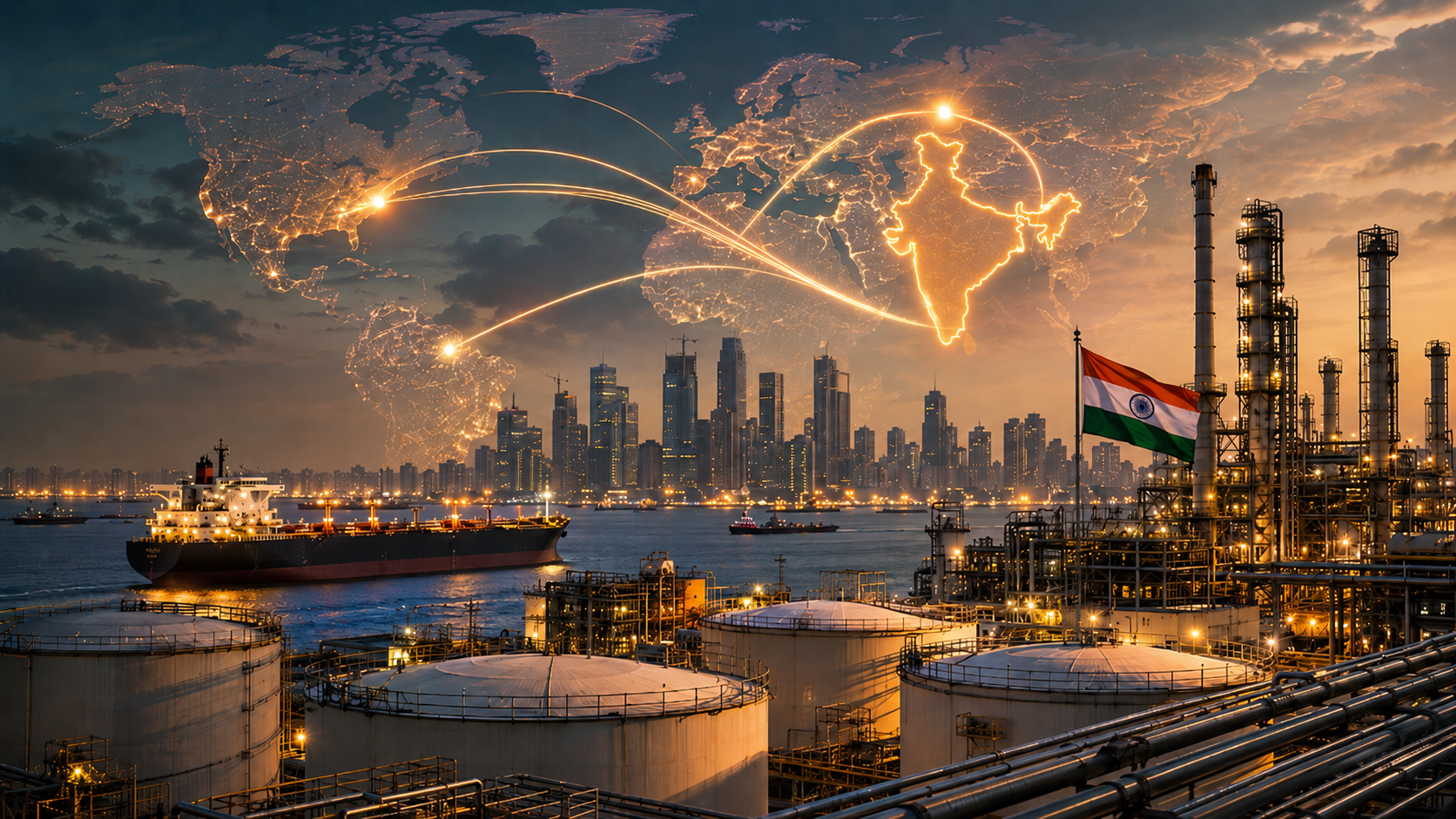
India’s energy security is again under pressure as global oil prices, Middle East tensions, fuel export duties, Russian crude flows, and strategic reserve planning become increasingly important for the country’s economic stability. The government’s latest fuel export duty changes show how closely India is watching international crude prices and domestic supply concerns.
According to Reuters, India recently revised fuel export duties, raising the export duty on petrol while reducing duties on diesel and aviation turbine fuel. The move came shortly after domestic retail fuel prices were increased for the first time since the beginning of the Iran war, showing how global oil pressure is influencing India’s fuel policy decisions.
India’s energy security has once again become a major national concern as global oil markets remain sensitive to conflict, sanctions, supply disruptions, and rising import costs. For a country that depends heavily on imported crude oil and gas, even small changes in global energy flows can affect fuel prices, inflation, transport costs, household budgets, industry, aviation, and government policy.
The latest signal came through India’s fuel export duty revision. Reuters reported that India raised the export duty on petrol to ₹3 per litre while reducing duties on diesel and aviation turbine fuel. These duties are reviewed periodically and are linked to global crude, petrol, diesel, and aviation fuel prices.
This may look like a technical tax decision, but it reveals something bigger: India is trying to carefully balance domestic fuel availability, refinery exports, government revenue, and global oil market pressure.
Why Energy Security Matters So Much for India
Energy security means having stable, affordable, and reliable access to fuel and power. For India, this is not just an economic issue. It is a national priority.
India is one of the world’s largest energy consumers. Its transport system, industries, agriculture, households, aviation sector, and power-linked infrastructure depend heavily on reliable energy supply. If oil prices rise sharply, the impact spreads across the economy.
Higher crude oil prices can increase petrol, diesel, LPG, and aviation fuel costs. This can raise transportation expenses, increase food distribution costs, push inflation higher, and reduce disposable income for ordinary families. Businesses may also face higher operating costs, especially in logistics, manufacturing, aviation, and agriculture-linked supply chains.
Reuters earlier explained that India is especially vulnerable to a global oil shock because it imports nearly 90% of its crude requirements and about 50% of its gas requirements. The same report noted that over half of India’s crude comes from the Middle East, where conflict-related disruptions can quickly affect supply routes and prices.
This is why every conflict, sanctions decision, shipping disruption, or production cut in the oil world matters for India.
Global Oil Pressure and Domestic Fuel Policy
India’s latest export duty revision shows how policymakers are trying to respond to changing oil conditions. When global prices are high, refiners may earn more from exports. But the government must also ensure that enough fuel remains available in the domestic market.
Reuters reported in March that India could review fuel exports if needed to protect local availability, with a petroleum ministry official saying domestic consumption was the priority during a period of global disruption and soaring oil prices.
This is important because India is not only a major oil importer. It is also a major refining hub. Indian refineries process crude and export refined petroleum products to global markets. In normal times, this supports revenue and trade. But in a crisis, the government must ensure that domestic supply is not affected.
For ordinary people, this matters because fuel prices influence daily life. Petrol and diesel affect transport. Diesel affects trucks, buses, agriculture machinery, and goods movement. Aviation turbine fuel affects airline costs. LPG affects households. Even if fuel prices do not rise immediately, sustained pressure can create wider economic concerns.
On The Thrive Journey News, we recently covered how fuel-related pressure can affect households in our report on India’s LPG crisis concerns.
Russian Oil and Sanctions Complicate the Picture
Russia has become a major part of India’s oil strategy in recent years. After Western sanctions and shifting global trade patterns, Indian refiners increased purchases of discounted Russian crude. This helped India manage import costs during a volatile period.
However, sanctions make this relationship complicated. Reuters reported in April that Russian oil sales to India were expected to remain near record highs in April and May following a US sanctions waiver, with refiners securing much of their supply through non-sanctioned entities and vessels.
The Economic Times also reported that Russian Foreign Minister Sergey Lavrov claimed Russian crude supplies to India had increased while India awaited an extension of a US waiver linked to sanctions on Russian oil imports.
This shows the delicate balancing act India must perform. On one side, it needs affordable energy for its economy. On the other side, it must manage relationships with the United States, Europe, Russia, Gulf countries, and other partners.
India’s position has generally focused on national interest: securing affordable energy while avoiding unnecessary geopolitical escalation. But as sanctions become more complex, oil trade becomes more difficult to manage.
Strategic Reserves Are Becoming More Important
One of the strongest long-term answers to energy risk is strategic petroleum storage. When a country has larger reserves, it can better handle sudden supply disruptions or price shocks.
Recent reports suggest that India’s crude storage strategy may receive a major boost. Times of India reported that Abu Dhabi National Oil Company may ramp up crude storage in India, potentially increasing India’s strategic reserve capacity significantly. The report said India’s crude security could rise by nearly 70% from the current 5.3 million tonnes if expansion plans move forward.
This is important because strategic reserves act like an insurance policy. They cannot permanently solve high oil prices, but they can provide temporary protection during supply disruption, war, shipping route blockage, or sudden import difficulty.
India’s partnership with the UAE also becomes relevant here. The UAE is not only an energy supplier but also a long-term strategic partner in trade, investment, petroleum, and infrastructure. Stronger Gulf cooperation can help India reduce uncertainty in the energy market.
For readers who want to understand India’s longer-term energy independence possibilities, our earlier report on India’s thorium-based nuclear energy vision is also relevant.
Why India Needs a Multi-Source Energy Strategy
India cannot depend on one country, one region, or one fuel source. A strong energy strategy must include multiple layers: crude oil imports from different suppliers, natural gas, strategic petroleum reserves, renewable energy, nuclear power, electric mobility, domestic exploration, refinery flexibility, and energy efficiency.
This is especially important because global energy politics is becoming unpredictable. Middle East conflicts can disrupt shipping. Sanctions can affect Russian supplies. OPEC decisions can influence prices. Currency movements can increase import costs. Climate policy can reshape investment. Technology can change demand patterns.
India’s long-term challenge is to keep energy affordable while also reducing vulnerability. That means improving storage, expanding renewables, investing in nuclear energy, strengthening international partnerships, and reducing wasteful consumption.
On the parent website, our Science & Technology section regularly explores how technology, energy, and innovation shape the future of society.
What This Means for Ordinary Consumers
For ordinary Indian families, energy security may sound like a policy term, but its effects are very real. Fuel prices influence school transport, office commute, food prices, delivery charges, cooking fuel, and travel costs.
When crude oil becomes expensive, the government faces difficult choices. It can absorb some pressure through taxes, pass some costs to consumers, adjust export duties, use reserves, negotiate supply deals, or support alternative energy growth. But none of these options is simple.
India’s latest fuel export duty move suggests that policymakers are trying to manage pressure without disturbing domestic fuel availability too sharply. But if global oil risks continue, India may need stronger measures to protect consumers and industries.
The bigger lesson is clear: India’s energy security is no longer just about buying oil. It is about diplomacy, sanctions, storage, shipping routes, refinery policy, clean energy, and strategic planning.
India’s Energy Future Will Depend on Resilience
India’s economy is growing, and energy demand will remain high for years. This makes energy security one of the most important foundations of India’s future. A country cannot become a manufacturing hub, digital economy, logistics power, or global growth engine without reliable energy.
The current global situation shows why India must remain alert. Oil prices, war risks, sanctions, shipping disruptions, and import dependence can quickly affect national stability.
The good news is that India is already working on multiple paths: stronger partnerships with Gulf nations, continued crude diversification, fuel policy adjustments, strategic reserve planning, renewable energy expansion, and future nuclear possibilities.
But the challenge remains serious. India must protect today’s consumers while building tomorrow’s energy independence.
In a world where fuel is linked with geopolitics, India’s energy strategy may become one of the most important tests of its economic strength.
According to Reuters’ report on India’s latest fuel export duty revision, the government raised the export duty on petrol while reducing export duties on diesel and aviation turbine fuel as global oil pressure continued to shape fuel policy
Source: Reuters
Read More: Latest News
Read More Interesting Content in My Blog Section of ‘The Thrive Journey’.