





Prime Minister Narendra Modi’s latest visit to the United Arab Emirates has brought India’s energy security, defence cooperation, investment strategy, and global trade ambitions back into sharp focus. The visit came at a time when the Middle East remains geopolitically sensitive and India is trying to protect its economic interests while expanding strategic partnerships across the Gulf, Europe, and other key regions.
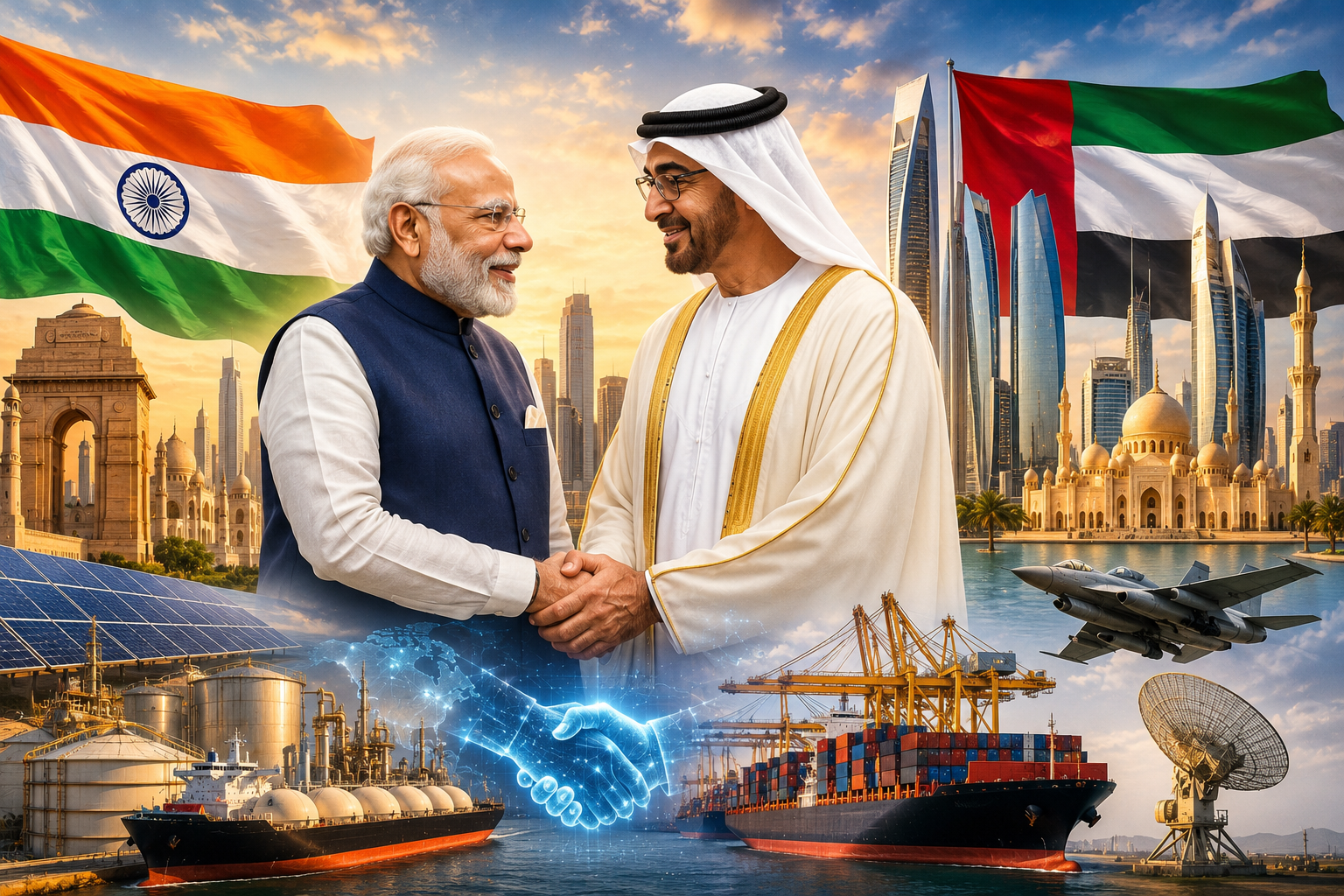
According to India’s Ministry of External Affairs, PM Modi paid an official visit to the UAE on May 15, 2026, where he was received by UAE President Sheikh Mohamed bin Zayed Al Nahyan and held high-level bilateral talks. The two sides reviewed cooperation across energy, trade, investment, defence, technology, and regional issues.
India’s relationship with the United Arab Emirates has become one of the most important pillars of New Delhi’s foreign policy in the Gulf region. Prime Minister Narendra Modi’s latest UAE visit has once again shown why this partnership matters not only for diplomacy, but also for India’s energy security, trade growth, investment ambitions, defence cooperation, and long-term economic stability.
The visit took place on May 15, 2026, during PM Modi’s wider multi-nation tour. The UAE was the first stop, making the Gulf nation a central part of India’s current global outreach. The Ministry of External Affairs confirmed that Modi was received by UAE President Sheikh Mohamed bin Zayed Al Nahyan and was accorded a ceremonial welcome.
This visit is important because India and the UAE are no longer limited to a traditional buyer-seller energy relationship. Their partnership has expanded into defence, shipping, infrastructure, digital technology, clean energy, food security, fintech, logistics, and investment. In a world facing wars, supply chain disruption, oil market uncertainty, and rising competition between major powers, India is trying to deepen ties with countries that can support both economic growth and strategic stability.
Energy Security Remains India’s Top Priority
Energy is one of the biggest reasons why the India-UAE relationship matters. India is one of the world’s largest energy consumers, and stable access to crude oil, gas, and future clean energy partnerships is critical for the country’s growth. Any instability in the Middle East can affect India’s fuel prices, import bill, inflation, and overall economic confidence.
Reuters reported that India and the UAE signed pacts covering defence and petroleum during Modi’s visit. This signals that energy cooperation remains a major focus, especially when global oil markets are sensitive to regional tensions.
For India, the UAE is not just an oil supplier. It is also an investment partner and a strategic gateway to the wider Gulf region. Stronger energy cooperation can help India manage uncertainty at a time when global conflicts, sanctions, and shipping risks are affecting supply chains.
The timing of the visit is also significant. Reuters earlier reported that Modi’s five-nation tour came amid concerns over rising oil prices linked to Middle East tensions, with the UAE stop expected to focus on energy cooperation and regional issues.
Defence and Maritime Cooperation Are Becoming More Important
India and the UAE are also increasing cooperation in defence and maritime security. This is important because the Indian Ocean, Arabian Sea, and Gulf shipping routes are crucial for trade and energy movement. Any disruption in these routes can affect global commerce.
Al Jazeera reported that India and the UAE signed defence-related pacts during the visit, with cooperation areas including maritime security, cyberdefence, communications, and information exchange.
For India, maritime security is directly linked with energy security. A large share of India’s energy imports moves through sea routes. If regional tensions rise, India needs strong partnerships with Gulf countries to protect trade flows, shipping safety, and strategic interests.
This also fits into India’s wider ambition to become a stronger Indo-Pacific and Indian Ocean power. New Delhi is increasingly building defence relationships with countries that can help maintain stability in important maritime corridors.
UAE Investment Could Support India’s Growth Story
The economic side of the visit is equally important. The New Indian Express reported that India and the UAE signed major agreements in energy, defence, trade, shipping, and advanced technology, while Abu Dhabi announced investment worth USD 5 billion in India during the visit.
Such investment matters because India is trying to accelerate infrastructure growth, manufacturing, digital transformation, clean energy, logistics, and technology development. UAE capital can support large-scale projects in India and help strengthen the country’s long-term economic base.
The India-UAE Comprehensive Economic Partnership Agreement, commonly known as CEPA, has already become an important framework for trade growth. The Press Information Bureau noted that both sides acknowledged the success of CEPA and its role in scaling bilateral trade.
For readers who follow India’s economic and technology transformation, this UAE visit connects with the larger question of how India can become a stronger global growth engine. On our parent website, we have explored how emerging technologies are reshaping economies and everyday life through our broader technology coverage.
Why This Visit Matters for Ordinary Indians
At first, a diplomatic visit may look like a high-level political event. But its impact can eventually reach ordinary people. Energy cooperation can influence fuel stability. Investment can create jobs. Trade deals can support exporters. Technology partnerships can open opportunities in digital services, logistics, artificial intelligence, fintech, and clean energy.
The UAE is also home to a large Indian community. Millions of Indians live and work in the Gulf region, and their remittances support families and local economies back home. Strong India-UAE relations therefore matter not only for governments, but also for workers, entrepreneurs, students, families, and businesses.
The UAE has also positioned itself as a major global hub for finance, aviation, logistics, and digital business. For India, closer cooperation with the UAE can help Indian companies reach markets in the Middle East, Africa, and Europe more efficiently.
This story also connects with our earlier international coverage of how global power shifts are reshaping trade and diplomacy. Readers can also see our latest coverage on US–China trade and AI talks here.
India’s Bigger Diplomatic Message
PM Modi’s UAE visit is part of a bigger diplomatic pattern. India is trying to maintain balanced relations with multiple power centers while protecting its own national interest. It works with the United States, Europe, Gulf countries, Japan, Russia, and Global South nations, depending on strategic and economic priorities.
The UAE partnership fits perfectly into this approach. It gives India energy security, trade opportunities, investment support, regional influence, and access to a major global business hub. At the same time, it allows the UAE to strengthen ties with one of the world’s fastest-growing major economies.
In the coming months, the real importance of this visit will depend on implementation. Agreements and announcements create momentum, but actual results will come from investment flows, trade growth, project execution, defence coordination, and energy cooperation.
Still, the message from the visit is clear: India and the UAE are trying to move beyond a traditional partnership and build a deeper strategic relationship for a more uncertain world.
For India, this is not just about one diplomatic meeting. It is about preparing for a future where energy, trade, technology, defence, and global partnerships will decide which countries remain strong in times of disruption.
According to the Ministry of External Affairs’ official statement on PM Modi’s UAE visit, the two leaders reviewed cooperation across energy, trade, investment, technology, defence, and regional issues.
Source: Ministry of External Affairs, Government of India
Read More: Latest News
Read More Interesting Content in My Blog Section of ‘The Thrive Journey’.