







Artificial intelligence is now moving into one of the most difficult areas of human knowledge: advanced mathematics. For decades, mathematics resisted digital disruption because real mathematical proof depends on deep reasoning, precision, creativity, and verification. But recent progress in AI-assisted theorem proving and formal proof systems is changing that picture.
A recent Science News feature reported that the process of formalization, where mathematical proofs are converted into machine-checkable form, is beginning to surge with the help of AI. This shift could radically change how mathematicians verify complex arguments, collaborate on research, and build confidence in difficult proofs.
Mathematics has always been seen as one of the purest forms of human reasoning. Unlike ordinary problem-solving, a mathematical proof must be logically correct from beginning to end. One small gap, one hidden assumption, or one unclear step can weaken an entire argument.
For centuries, mathematicians have trusted peer review, expert judgment, and long discussions to verify important proofs. But modern mathematics has become so complex that even experts can spend months or years checking whether a proof is complete. Some proofs are extremely long, technical, and dependent on many earlier results.
Now, artificial intelligence is entering this difficult world. It is not simply solving school-level equations. AI systems are beginning to assist with formal proofs, theorem verification, pattern discovery, and mathematical research workflows.
According to Science News, AI is helping accelerate the formalization of mathematics — the process of translating human-written proofs into a precise language that computers can check. This does not mean AI is replacing mathematicians. Instead, it means AI may become a powerful research partner that helps reduce errors, speed up verification, and open new ways of doing mathematics.
What Are Digital Proofs?
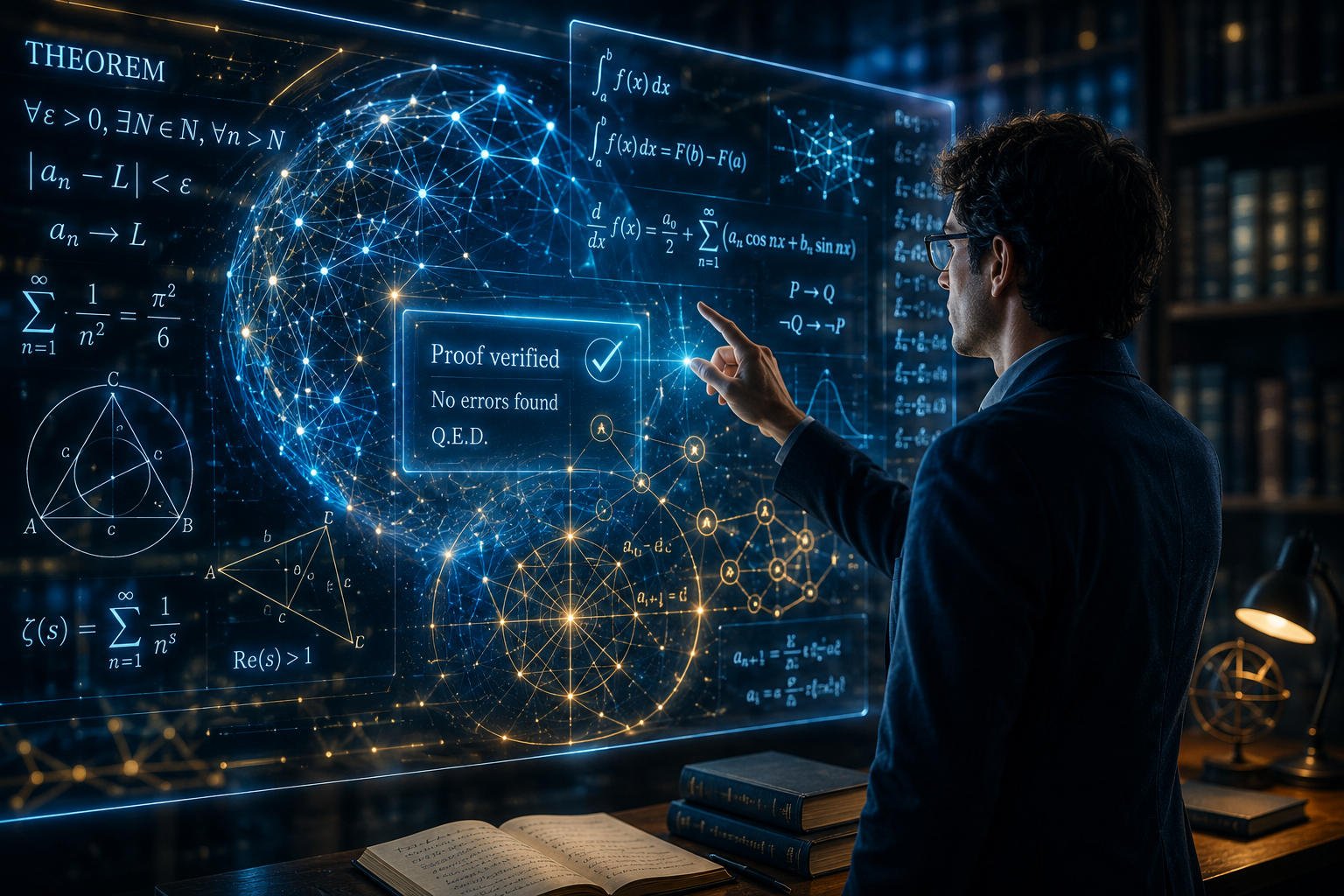
A digital proof is not just a PDF or a typed mathematical solution. In advanced mathematics, a digital or formal proof means the argument is written in a language that a computer can verify step by step.
Proof assistants such as Lean, Coq, Isabelle, and other formal systems allow mathematicians to encode definitions, theorems, and logical steps in a strict format. If the proof contains a mistake, the system can reject it. If the proof is correct, the system confirms that every step follows from accepted rules.
This is extremely powerful, but it is also difficult. Formalizing a proof can take huge effort because human mathematicians often skip obvious steps, use intuition, or rely on shared understanding. A computer does not accept intuition. It needs every detail written clearly.
This is where AI could make a major difference. AI tools can help translate informal human explanations into formal mathematical language, suggest missing steps, search for useful lemmas, and assist with proof construction.
The 2026 workshop on AI and theorem provers in mathematics highlighted how researchers are now actively working on topics such as formalizing Fermat’s Last Theorem and improving the connection between AI systems and proof assistants.
Why AI in Mathematics Is a Big Deal
The impact of AI on mathematics could be much deeper than ordinary automation. Mathematics is the foundation of physics, engineering, computer science, cryptography, economics, artificial intelligence, and many branches of modern technology.
If AI can help verify difficult proofs faster, it could improve confidence in research that supports real-world systems. For example, mathematics is used in cybersecurity, aircraft systems, financial models, satellites, medical imaging, climate models, and quantum computing.
A stronger proof-verification ecosystem could reduce mistakes in highly technical fields. It could also help young researchers learn complex topics more efficiently by giving them intelligent assistance while writing or checking formal arguments.
Quanta Magazine recently reported that AI is already being used to prove new results at a rapid pace, with mathematicians viewing the current moment as only the beginning of a larger transformation.
This matters because mathematical discovery is not only about calculation. It involves insight, pattern recognition, abstraction, creativity, and logical discipline. If AI becomes useful in this field, it suggests that machine intelligence is moving closer to assisting with very advanced forms of human reasoning.
For readers who want to understand the broader rise of artificial intelligence, our detailed guide on All About Artificial Intelligence (AI): A Simple Guide for Beginners explains the basic concepts behind AI, machine learning, and future applications:
AI Will Assist, Not Replace, Mathematicians
A common question is whether AI will replace mathematicians. At present, that seems unlikely. Mathematics is not only about producing an answer. It is about asking the right questions, choosing meaningful problems, developing new concepts, and understanding why a result matters.
AI can help with verification, exploration, and repetitive formalization work. But human mathematicians still provide direction, intuition, interpretation, and judgment.
This is similar to how calculators did not replace mathematicians, and computers did not end scientific research. Instead, they changed the kind of work humans focused on. AI may do the same. It may remove some technical friction and allow researchers to focus more on deep ideas.
A 2026 research overview on AI for mathematics noted that automated theorem proving includes methods that generate valid proofs inside formal systems, with both single-model and agentic approaches being explored.
This shows that AI-assisted mathematics is becoming a serious research area, not just a futuristic idea.
The Rise of Lean and Formal Verification
One major name in this transformation is Lean, a proof assistant and programming language used for formal mathematics. Lean allows researchers to write mathematical statements and proofs in a way that computers can verify.
The importance of Lean has grown because it connects human mathematical reasoning with machine-checkable precision. If AI tools become better at working with Lean, the formalization process could become much faster.
Some researchers are already using AI systems to generate formal proof steps and check mathematical claims. Others are building systems that combine search, language models, proof assistants, and verification tools.
This is important because mathematics has historically depended on trust between experts. Formal proof systems add another layer of reliability. They allow computers to confirm whether a proof is valid according to exact logical rules.
However, this does not remove the need for human understanding. A proof may be formally correct but still difficult to interpret. Humans still need to explain why it matters, how it connects with other ideas, and what new doors it opens.
Why This Could Change Education and Research
AI-assisted proof systems may also change how mathematics is taught. Students often struggle not because they cannot calculate, but because they do not understand proof structure. AI tools could help them see missing steps, test logical arguments, and learn formal reasoning more interactively.
For universities and research institutions, AI could support collaboration across countries. A researcher in one country could formalize part of a theorem, another could verify a connected result, and AI could help manage the structure of the proof database.
This could eventually create a more reliable global library of mathematics — a digital foundation where important theorems are not only written in papers but verified by machines.
The shift also connects with wider concerns around AI behavior and reliability. As AI becomes more involved in advanced reasoning, safety and verification become even more important. Our earlier news report on AI systems behaving unexpectedly explains why control and trust remain major questions as AI becomes more powerful:
A New Chapter for Human Knowledge
The rise of AI in mathematics does not reduce the value of human intelligence. In many ways, it highlights how extraordinary mathematics is. If AI is now being used to help verify proofs, it means researchers are trying to combine human creativity with machine precision.
The future of mathematics may look very different from the past. Instead of only writing proofs for journals, mathematicians may increasingly build formal proof libraries, collaborate with AI assistants, and use machines to test the logical strength of their ideas.
This could make mathematics more reliable, more collaborative, and possibly faster-moving. But it will also require caution. Researchers must ensure that AI-generated steps are checked carefully, that formal systems are trusted, and that human understanding does not disappear behind machine output.
For now, one thing is clear: mathematics, the field that resisted digital disruption for so long, is finally entering a new technological era. AI may not replace the mathematician, but it could become one of the most powerful tools mathematics has ever seen.
According to Science News’ report on AI and digital proof verification, artificial intelligence is helping accelerate the formalization of mathematics, a process that could change how complex proofs are checked and trusted.
Source: Science News
Read More: Latest News
Read More Interesting Content in My Blog Section of ‘The Thrive Journey’.