







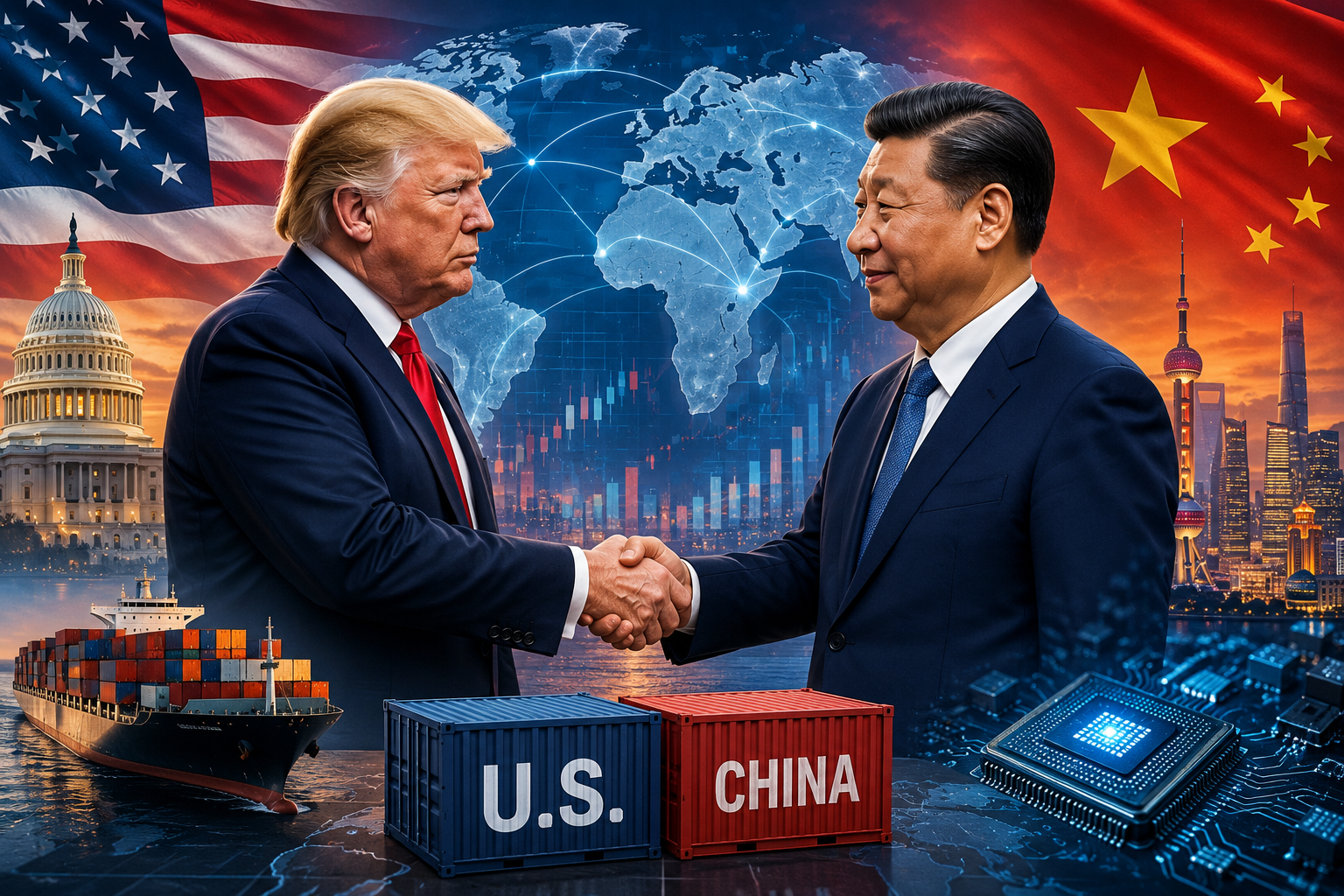
The latest Trump–Xi meeting in Beijing has put US–China relations back at the center of global attention, with both sides discussing trade, tariffs, agriculture, aviation, technology, artificial intelligence, Taiwan, and wider geopolitical tensions. While the summit produced positive signals, China described the outcomes as “preliminary,” meaning the real impact will depend on how both countries convert diplomatic promises into concrete agreements.
According to Reuters, China said the two sides discussed tariff reductions, market access, agricultural trade, aviation cooperation, and non-tariff barriers, but several details such as product lists, timelines, volumes, and final commitments remain unclear.
The latest meeting between US President Donald Trump and Chinese President Xi Jinping has once again placed the world’s two largest economies at the center of global debate. The summit, held in Beijing, was closely watched not only by diplomats but also by businesses, investors, farmers, technology companies, and governments across Asia, Europe, and the rest of the world.
At first glance, the meeting appeared to send a positive message. Both sides discussed trade, tariffs, agricultural market access, aviation, technology, and wider geopolitical issues. But beneath the diplomatic language, one thing is clear: the US–China relationship remains complicated, competitive, and extremely important for the global economy.
China’s Commerce Ministry described the outcomes of the visit as productive but still “preliminary,” according to Reuters. This means that while both countries may have agreed on broad directions, many specific details are still pending. The real test will begin when negotiators attempt to convert summit-level statements into final agreements.
Trade Talks Return to the Center
Trade was one of the most important subjects during the summit. The United States and China have spent years dealing with tariff disputes, supply chain tensions, technology restrictions, and market access issues. Any shift in this relationship can affect global prices, manufacturing, agriculture, shipping, and investor confidence.
Reuters reported that China signaled tariff reductions and improved market access for US agricultural products after the summit. The report also noted that bilateral farm trade had fallen sharply in 2025, partly due to earlier tariff pressure. China’s latest signals suggest an effort to rebuild some trade flows, especially in agricultural goods such as soybeans, wheat, sorghum, beef, and poultry-related products.
For American farmers, this could be important because China has historically been a major buyer of US agricultural exports. For China, stable food imports can help manage domestic supply and prices. But for the rest of the world, the message is even bigger: when Washington and Beijing talk about trade, global markets listen.
However, the details remain limited. Reuters noted that China did not provide full specifics on participating companies, exact values, product volumes, or final timelines in several areas. This is why the summit should be seen as a diplomatic opening rather than a completed reset.
AI and Technology Are Now Strategic Issues
Unlike older US–China meetings that focused mainly on goods and tariffs, today’s relationship is also shaped by technology and artificial intelligence. AI is no longer just a business tool. It has become a strategic asset linked to national security, economic growth, defense capability, chip production, automation, and global influence.
The Council on Foreign Relations noted that discussions around advanced chips and AI-related computing capacity remain highly significant in the US–China relationship. Any change in access to high-performance chips or AI infrastructure could affect China’s computing power and the wider global AI race.
This matters because both countries are competing for leadership in artificial intelligence. The US has major AI companies, cloud infrastructure, semiconductor design capabilities, and research institutions. China, on the other hand, has large-scale data resources, strong state-backed technology programs, and rapidly growing AI companies.
For readers following the future of machine intelligence, this summit connects directly with the bigger question of how AI leadership may shape global power. On our parent blog, we explained this deeper transformation in our article on Artificial General Intelligence and the future of advanced machine intelligence.
Taiwan Remains a Sensitive Flashpoint
Even as trade and technology talks moved forward, Taiwan remained one of the most sensitive issues between the US and China. The Taiwan question is not only a diplomatic dispute. It is also tied to military strategy, semiconductor supply chains, regional alliances, and the security balance in the Indo-Pacific.
Soon after Trump’s Beijing visit, Taiwan’s Ministry of National Defense reported Chinese naval activity around the island, according to Times of India. The report said Taiwan detected eight Chinese naval vessels and one official ship around the island, with one ship entering Taiwan’s territorial waters.
This shows why US–China diplomacy cannot be judged only by trade announcements. Even when leaders meet and speak positively, security tensions can continue at the same time. For Asian countries, especially India, Japan, South Korea, Australia, and ASEAN nations, the Indo-Pacific balance remains a major concern.
This also connects with our earlier coverage of America’s strategic positioning in the Indo-Pacific. Readers can understand the wider regional context through our report on US defence shifts in the Indo-Pacific and why they matter for India and global stability.
Why the Summit Matters for India
India may not have been directly present at the summit, but the outcome still matters for India’s economy and foreign policy. Any improvement in US–China trade can influence global supply chains, commodity prices, shipping routes, technology flows, and investor confidence.
At the same time, India is trying to strengthen its role as an alternative manufacturing and technology hub. If US–China tensions reduce sharply, some companies may slow their diversification plans. But if tensions remain unresolved, India could continue to benefit from global firms looking for supply chain alternatives.
India’s strategic position also becomes important because it maintains relationships with the United States while managing a complex border and trade relationship with China. A stable Indo-Pacific environment supports India’s economic and security interests. But any escalation around Taiwan, technology controls, or maritime routes could create new pressure.
For Indian businesses, the message is simple: US–China relations are not distant foreign affairs. They can affect electronics prices, semiconductor supply, exports, energy markets, logistics costs, and investment patterns.
A Diplomatic Opening, Not a Final Solution
The Trump–Xi summit should be seen as a major diplomatic moment, but not a complete solution. The meeting created space for further negotiations, especially on tariffs, agricultural trade, aviation, and market access. But many details remain unfinished.
The positive side is that both sides are still talking. In a world already dealing with inflation pressure, energy concerns, AI disruption, and geopolitical instability, communication between Washington and Beijing is important.
The cautious side is that US–China competition has become structural. Trade disagreements, AI rivalry, semiconductor controls, Taiwan tensions, military positioning, and ideological differences will not disappear because of one summit.
For the global economy, the summit offers hope of reduced friction. For technology markets, it raises questions about how AI and chips will shape future power. For Asia, it confirms that the Indo-Pacific will remain one of the most important strategic regions in the world.
The coming months will show whether this summit becomes a genuine turning point or just another temporary pause in a long competition between two global giants.
According to Reuters’ report on preliminary US–China summit deals, both countries discussed tariff reductions, agriculture, aviation, and market access, but several final details still remain unclear.
Source: Reuters
Read More: Latest News
Read More Interesting Content in My Blog Section of ‘The Thrive Journey’.