





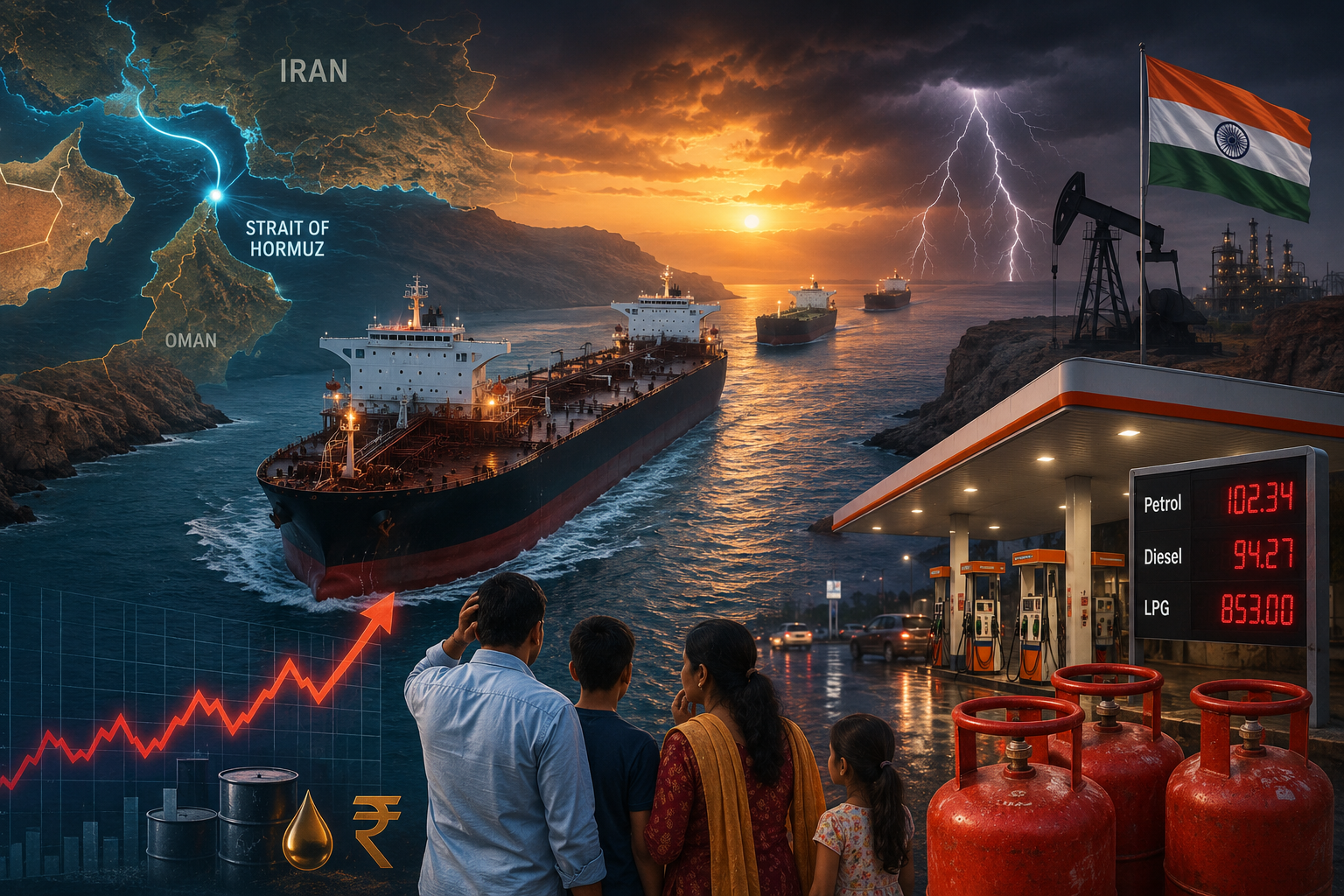
The Strait of Hormuz is one of the world’s most sensitive energy routes, and any tension there can quickly affect oil, LPG and shipping markets.
For India, the risk is serious because petrol, diesel, aviation fuel and LPG cylinder costs are closely linked to global crude and gas supply chains.
Recent reports suggest some Indian tankers have safely crossed the route, but uncertainty remains high.
Here is why one narrow sea passage can create worry for Indian households, drivers, airlines and the wider economy.
One narrow sea route is again making the world nervous. The Strait of Hormuz, located between Iran and Oman, may look small on the map, but its impact on global energy markets is enormous. When tension rises around this route, oil traders react, shipping companies become cautious, insurers raise risk premiums, and countries like India start watching petrol, diesel and LPG supply more closely.
This is why the latest Strait of Hormuz tension is not just a foreign-policy story. It is a household-budget story. It can affect the price of petrol in a bike, diesel in trucks, jet fuel for airlines and LPG cylinders used in Indian kitchens.
The latest relief is that three Indian-flagged oil tankers reportedly cleared the Strait of Hormuz safely, carrying more than 860,000 metric tonnes of oil and 94 Indian crew members. But the bigger concern has not disappeared: if the route becomes unsafe again, energy prices can move quickly.
Why the Strait of Hormuz Matters So Much
The Strait of Hormuz is one of the most important oil chokepoints in the world. A chokepoint means a narrow route through which huge volumes of energy cargo must pass. If traffic slows, shipping gets delayed. If conflict escalates, prices can jump before actual shortages even begin.
For India, this matters because the country depends heavily on imported crude oil and LPG. Crude oil becomes petrol, diesel, aviation turbine fuel, petrochemicals and several other products. LPG is directly linked to cooking gas cylinders used by millions of households.
This is why even a rumour of disruption can make global markets nervous. Oil prices do not wait for empty petrol pumps. They react to fear, risk and future supply expectations.
India has already tried to reduce direct dependence on one route by diversifying crude purchases. The government has said India now imports crude from many countries and that a larger share of crude is coming from routes outside the Strait of Hormuz compared with earlier. That is a positive safety cushion.
But LPG is more sensitive. India imports a major share of its LPG needs, and a large part of those imports depend on the Middle East route. So even if petrol and diesel remain stable for some time, LPG supply and cost pressure can become a bigger concern if the route stays risky.
For readers who want to understand why India is pushing alternative fuels, our earlier report on Ethanol Fuel for Vehicles Gains Momentum in India explains how ethanol blending is being seen as one way to reduce petrol import dependence over time.
How Hormuz Tension Can Affect Indian Consumers
The impact does not always appear immediately. India usually has inventories, long-term contracts, diversified crude sources and government-managed pricing mechanisms. But if the tension continues, the pressure can slowly reach consumers.
Here is the simple chain:
| Global Event | Market Reaction | Possible India Impact |
|---|---|---|
| Tension rises near Strait of Hormuz | Oil traders fear supply disruption | Crude oil prices may rise |
| Tankers face security risk | Shipping and insurance costs increase | Imported crude and LPG become costlier |
| LPG cargoes get delayed | Supply planning becomes difficult | LPG cylinder cost pressure may rise |
| Crude becomes expensive | Refining cost increases | Petrol and diesel price pressure may build |
| Global oil remains volatile | Rupee and inflation pressure can increase | Transport, food and household costs may rise |
| Shipping routes become uncertain | Companies search for alternate supply | India may buy more from Russia, Africa, Latin America or the US |
The biggest immediate risk is not always shortage. It is price volatility. Fuel prices can rise because markets fear what may happen next.
India’s oil marketing companies and government policy can absorb some shocks for a while. But if global crude remains high for weeks or months, the pressure eventually becomes harder to ignore.
India Impact Tracker: Petrol, Diesel, LPG and Economy
Here is a useful at-a-glance table for readers who want the practical impact in one place.
| Area | Risk Level | Why It Matters | What Indians Should Watch |
| Petrol | Medium | Petrol depends on crude oil prices and refining costs | Brent crude price, rupee movement, government fuel updates |
| Diesel | Medium to High | Diesel affects trucks, buses, agriculture and logistics | Transport cost, vegetable prices, freight rates |
| LPG Cylinder | High | India imports a major share of LPG, much of it linked to Middle East routes | LPG import news, cylinder price updates, subsidy changes |
| Aviation Fuel | Medium | Expensive crude can raise airline operating costs | Airfare trends, airline fuel surcharge |
| Inflation | Medium | Fuel cost affects transport and supply chains | Food prices, wholesale inflation, retail inflation |
| Rupee | Medium | Higher oil import bills can pressure the rupee | USD-INR movement, RBI commentary |
| Government Budget | Medium | Fuel subsidies or price control can affect fiscal planning | Subsidy announcements, oil ministry statements |
The most important point is this: a Hormuz crisis may not instantly raise every Indian fuel price the next morning, but it creates pressure across the entire energy chain.
Why LPG Is the Most Sensitive Household Issue
For common people, LPG is the most emotional part of this story. Petrol and diesel affect transport, but LPG touches the kitchen directly. Any sharp increase in global LPG prices can become politically and socially sensitive in India.
Indian households are used to regular LPG cylinder supply, and any disruption creates immediate worry. Even if the government and oil marketing companies absorb some price shock, long disruption can still affect procurement cost, subsidy pressure and supply planning.
That is why India has been exploring diversification. More crude can be sourced from Russia, Latin America, Africa and other regions. LPG diversification is more difficult because India’s LPG demand has a specific composition and supply pattern. Middle Eastern LPG remains important because it is suitable for India’s domestic cooking-gas requirements.
This is also why long-term energy security matters. India cannot depend only on one fuel, one region or one route. The future will require a combination of crude diversification, ethanol blending, electric mobility, domestic gas, cleaner cooking solutions, storage capacity and better energy technology.
On The Thrive Journey, we have also discussed how future technologies can reshape energy systems in Nanotechnology: Engineering Reality at the Atomic Scale, where advanced materials, batteries and energy innovation are explained in simple terms.
Should Indians Panic About Petrol and LPG Prices?
No, panic is not the right response. But awareness is important.
India has strategic tools: diversified crude suppliers, public-sector oil companies, diplomatic channels, shipping coordination, refinery planning and pricing control mechanisms. The recent safe movement of Indian tankers through the Strait is a positive sign.
However, the risk is not zero. If conflict rises again or if shipping companies become afraid of operating in the region, the market can become unstable. Prices may rise even before actual supply shortage happens because global traders price in risk.
For normal consumers, the best thing is to watch three indicators:
| Indicator | Why It Matters |
| Brent crude price | Shows global oil price pressure |
| LPG import and cylinder updates | Shows household cooking-gas impact |
| Official oil ministry statements | Shows India’s supply and price position |
Why This Topic Can Bring High Traffic
This topic has strong traffic potential because it connects global conflict with daily Indian life. People may not search for foreign-policy details, but they do search for questions like:
“Will petrol price increase in India?”
“Will LPG cylinder price rise?”
“Strait of Hormuz impact on India”
“Iran tension petrol price India”
“LPG shortage India news”
“Crude oil price India today”
That makes this story powerful for a news website. It is not only about geopolitics. It is about money, fuel, kitchen cost, transport cost and inflation.
The Strait of Hormuz may be far from Indian homes, but its impact can travel quickly through oil tankers, shipping insurance, refinery costs and household budgets.
One sea route can create global panic because modern life still runs on energy. And for India, the message is clear: energy security is not just about having fuel today. It is about making sure no single route, region or crisis can shake the country’s future.
Source: Reuters report on Indian oil tankers clearing the Strait of Hormuz
Read More: Latest News
Read More Interesting Content in My Blog Section of ‘The Thrive Journey’.