
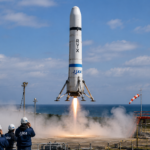







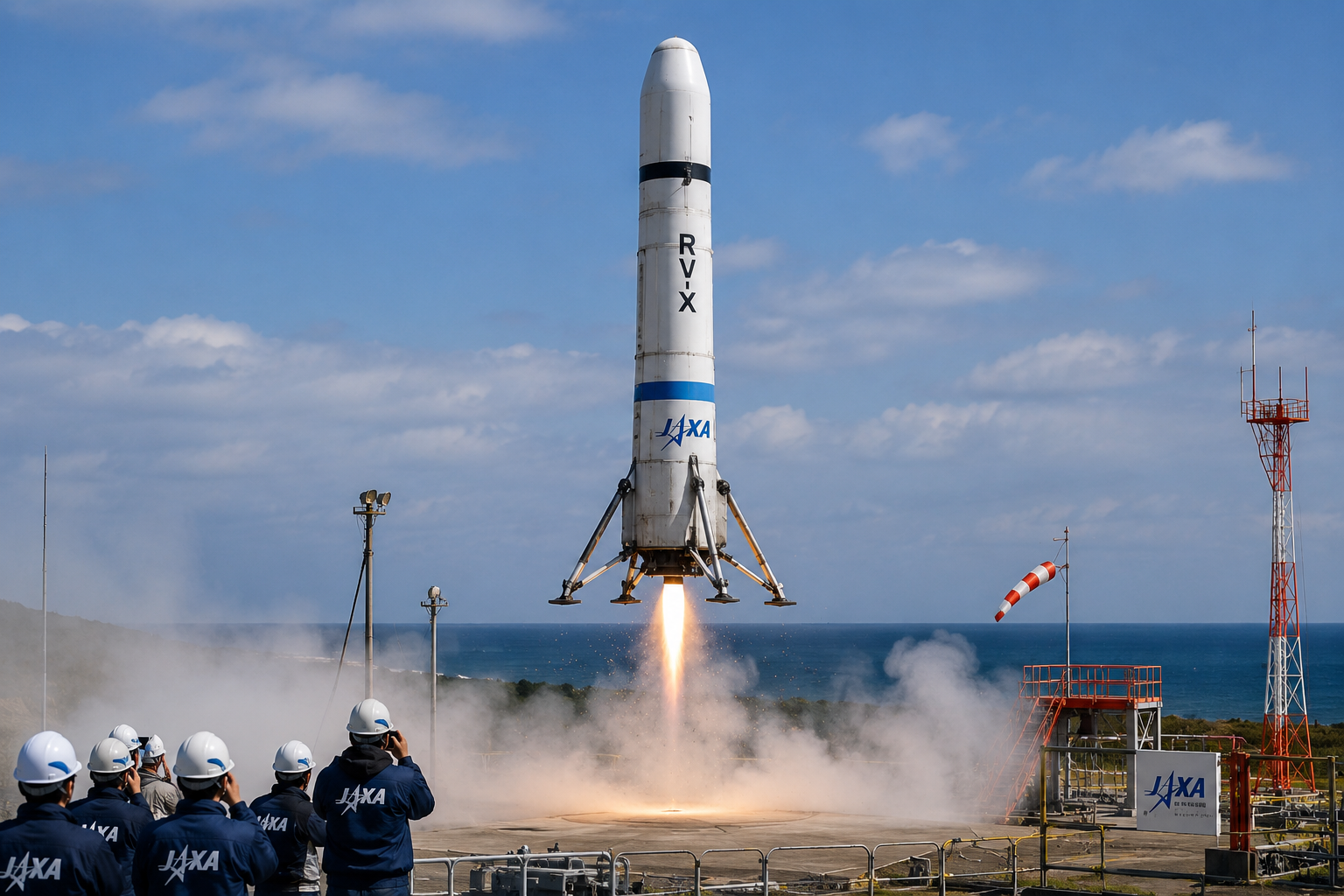
Japan has completed the first successful flight test of its experimental reusable rocket, RV-X. The compact vehicle lifted off, hovered, moved sideways and landed upright at a JAXA testing facility in northern Japan. Although the flight lasted less than a minute and reached only 11 metres, it demonstrated essential launch-and-landing technology that could eventually help Japan reduce rocket costs and compete more strongly in the global space industry.
Japan has taken an important step towards reusable spaceflight after its experimental RV-X rocket completed a controlled takeoff and safe vertical landing.
The test was conducted on July 11 at the Japan Aerospace Exploration Agency’s Noshiro Rocket Testing Center in northeastern Japan. During the demonstration, the rocket rose vertically, remained stable in the air, travelled horizontally and returned safely to the ground while maintaining its upright position.
The achievement does not mean Japan has developed a fully operational reusable orbital rocket yet. RV-X is a technology demonstrator designed to test the engines, navigation, stability and landing systems required for more ambitious reusable launch vehicles in the future.
Japan’s RV-X Test at a Glance
| Test detail | Information |
|---|---|
| Rocket name | Reusable Vehicle eXperiment, or RV-X |
| Organisation | Japan Aerospace Exploration Agency |
| Industry partner | Mitsubishi Heavy Industries |
| Test location | Noshiro Rocket Testing Center, Japan |
| Test date | July 11, 2026 |
| Maximum altitude | Approximately 11 metres |
| Horizontal movement | Approximately 16 metres |
| Flight duration | Less than one minute |
| Landing result | Successful upright landing |
| Vehicle height | Approximately 7.3 metres |
| Vehicle diameter | Approximately 1.8 metres |
| Future test target | Flights reaching around 100 metres |
The test vehicle reached a height of approximately 11 metres and travelled around 16 metres horizontally before landing as planned. JAXA project manager Takashi Ito confirmed that the rocket completed the intended flight sequence while maintaining its vertical position.
Video footage of the test showed the vehicle rising above the launch platform, hovering briefly and gradually shifting position before descending onto its four landing legs.
The short flight may appear modest when compared with orbital rocket launches, but vertical landing requires extremely accurate control. The vehicle must regulate engine power, orientation and movement continuously while responding to changes in balance and external conditions.
Why This Small Rocket Test Matters
Most traditional rockets are designed for one-time use. After delivering a satellite or spacecraft, major sections of the launch vehicle are discarded, destroyed during re-entry or allowed to fall into the ocean.
Reusable rockets are different. Their major components are designed to return safely so they can potentially be inspected, prepared and flown again. Reusing expensive hardware can reduce the cost of individual launches, although the savings depend on refurbishment, reliability and how frequently the vehicle can fly.
SpaceX has demonstrated the commercial value of reusable rocket stages through repeated Falcon 9 booster landings. Japan is now working to develop its own reusable capability so that it does not fall behind in a launch market where customers increasingly expect lower prices and frequent missions.
RV-X is being jointly developed by JAXA and Mitsubishi Heavy Industries. The vehicle is approximately 7.3 metres long and 1.8 metres wide, and it uses four shock-absorbing landing legs to support a controlled return to the ground. Its engine has reportedly completed 165 combustion tests as engineers study its durability for repeated operation.
This focus on reusable launch systems is part of a wider transformation taking place across Asia. India is also expanding its commercial space infrastructure, as explained in our report on how India’s new space hubs could strengthen private rocket and satellite manufacturing.
How RV-X Fits into Japan’s Space Ambitions
Japan currently relies heavily on the H3 rocket for major national launches. The H3 was developed as a more affordable replacement for the highly successful H-2A series, but it remains an expendable system whose major stages are not designed for routine recovery and reuse.
JAXA hopes that knowledge gained from RV-X can contribute to a future successor that is cheaper and more commercially competitive. Such a launch vehicle could support satellite deployment, scientific missions, national-security payloads and future exploration programmes.
Japan’s government considers reliable and commercially competitive space transportation important not only for business but also for national security. Countries increasingly depend on satellites for navigation, communication, weather monitoring, disaster response and defence-related services. Having independent launch capability reduces reliance on foreign providers.
Japan is also working with France and Germany on reusable-rocket research. International cooperation may help engineers share test data, improve propulsion systems and explore designs suitable for future European and Japanese missions.
The RV-X flight came shortly after reports that China had successfully recovered the first stage of a rocket following launch. That timing highlights the growing competition among Asian space programmes to master reusable technology and secure a stronger share of the global launch market.
For a wider view of how reusable rockets, private launch companies and new missions may transform human activity beyond Earth, readers can explore The Future of Space Exploration: Missions That Will Change Humanity Forever.
What Happens Next for Japan’s Reusable Rocket
JAXA plans to conduct more demanding RV-X tests, including flights reaching an altitude of around 100 metres. These higher tests will give engineers more time to evaluate navigation, engine throttling, flight control and landing accuracy.
Future reusable vehicles will need to perform far beyond the short RV-X demonstration. An operational booster must survive high speeds, aerodynamic pressure, extreme temperatures and the demanding return from the upper atmosphere.
Engineers must also prove that reusable components can withstand repeated flights without requiring expensive repairs after every mission. A rocket that can land but needs extensive rebuilding may not deliver the expected financial advantage.
Japan’s latest test should therefore be viewed as a promising first step rather than a finished breakthrough. RV-X did not enter space, carry a satellite or return from orbital speed. However, it successfully demonstrated the controlled movement and vertical landing that form the foundation of reusable-rocket technology.
The flight gives Japan valuable practical data and shows that its reusable launch programme has moved from laboratory development to real-world testing. As future flights become higher and more complex, RV-X could help shape the rocket that eventually succeeds the H3 and strengthens Japan’s position in the rapidly changing global space economy.
Source: Associated Press: Japan’s space agency conducts first test flight for experimental reusable rocket
Read More: Latest News
Read More Interesting Content in My Blog Section of ‘The Thrive Journey’.