







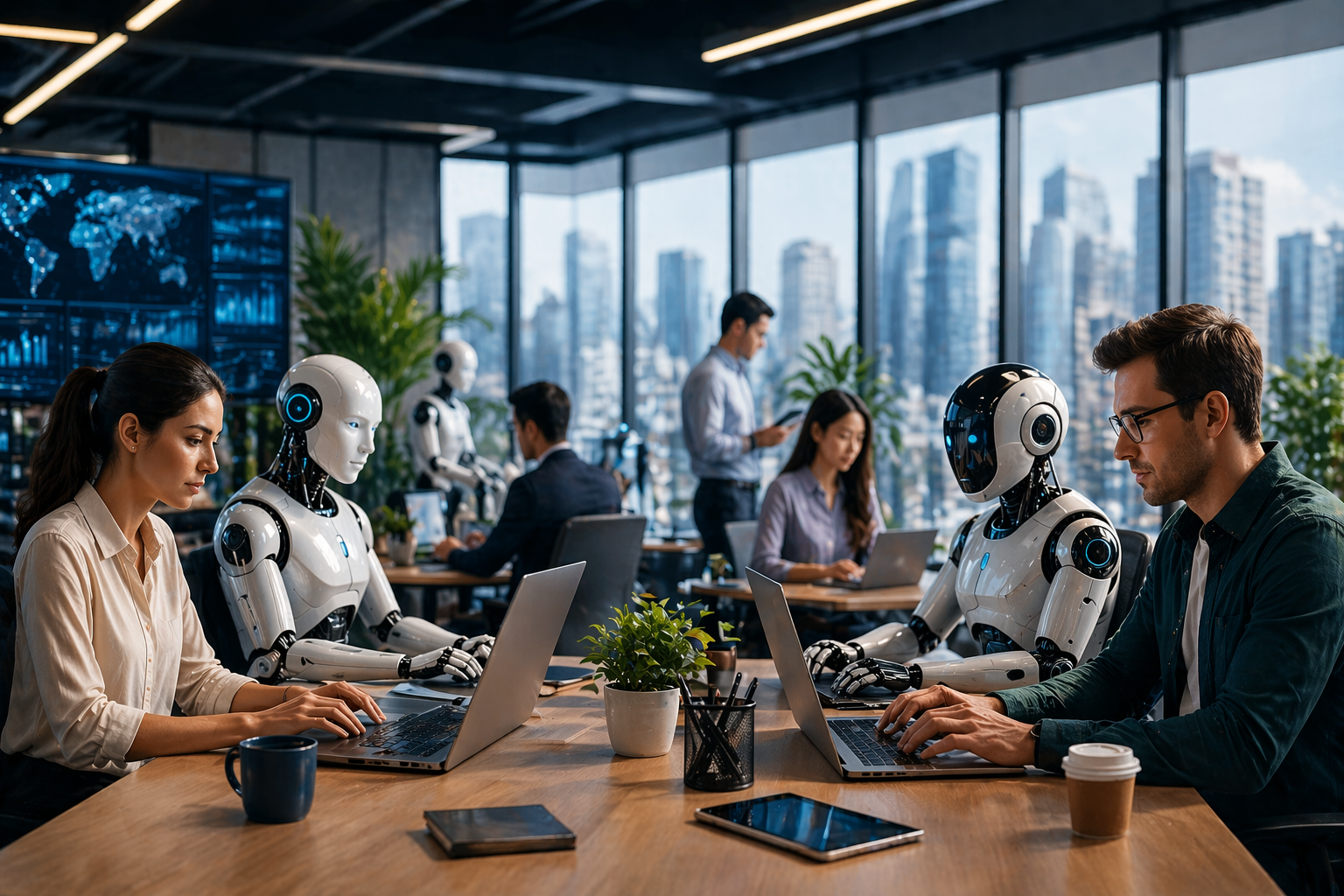
A major global shift in employment patterns is unfolding as artificial intelligence continues to reshape industries. While some roles are disappearing, new opportunities are emerging rapidly. Experts warn that adaptation—not resistance—will determine who thrives in this evolving job landscape.
AI Is No Longer a Future Threat — It’s a Present Reality
Artificial Intelligence is no longer a distant concept discussed in tech conferences—it is actively transforming the global workforce. From banking and customer service to logistics and healthcare, automation is redefining how work gets done.
Recent global reports indicate that millions of repetitive and rule-based jobs are being phased out, while demand for AI-related roles, data analysis, and creative problem-solving skills is rising sharply.
Experts suggest that this is not a “job loss crisis” but a job transformation wave.
Industries Facing the Biggest Disruption
Several sectors are already experiencing visible impact:
- Customer Support: AI chatbots handling 60–70% of queries
- Finance & Banking: Automated risk analysis and fraud detection
- Manufacturing: Robotics replacing manual assembly lines
- IT Services: Code generation tools reducing manual development work
At the same time, new roles like AI trainers, prompt engineers, and automation specialists are growing.
This shift aligns closely with how technology adoption historically evolves—slow at first, then rapidly accelerating.
Why This Shift Is Different From Past Revolutions
Unlike previous industrial revolutions, AI impacts both blue-collar and white-collar jobs simultaneously.
Earlier, automation mainly affected physical labor. Today, even knowledge-based roles—such as content writing, coding, and data processing—are being transformed.
This is why experts are calling it a “cognitive revolution” rather than an industrial one.
If you want to understand how AI is already embedded into daily life, you can explore this detailed breakdown:
👉 How AI is shaping everyday human decisions
Opportunities Emerging From the Shift
Despite concerns, this transformation is creating significant opportunities:
- Demand for AI-literate professionals is increasing
- Freelancing and digital entrepreneurship are expanding
- Hybrid roles combining human creativity + AI efficiency are emerging
- Businesses are investing heavily in upskilling employees
Companies that adapt quickly are gaining a competitive edge, while individuals who upgrade their skills are seeing faster career growth.
A related development was recently highlighted in another report:
👉 AI systems behaving unpredictably raises new concerns
The Real Risk: Skill Gap, Not Job Loss
The biggest challenge is not AI itself—but the gap between existing skills and future requirements.
Many workers are still trained for traditional roles, while industries are moving toward:
- Automation management
- Data-driven decision-making
- AI-assisted workflows
This mismatch is creating short-term disruption but long-term opportunity.
Global Response: Governments and Companies Step In
Countries like the US, India, and China are actively investing in:
- AI education programs
- Skill development initiatives
- Digital infrastructure expansion
Large corporations are also launching internal training programs to prepare employees for AI integration.
According to a World Economic Forum report, nearly 50% of employees will need reskilling by 2030 due to AI adoption.
What This Means for You
The message is simple:
AI will not replace humans—but humans who use AI will replace those who don’t.
Adapting early, learning continuously, and embracing technology will be the key to staying relevant in this rapidly changing environment.
Source: Weforum
Read More: Latest News
Read More Interesting Content in My Blog Section of ‘The Thrive Journey’.