








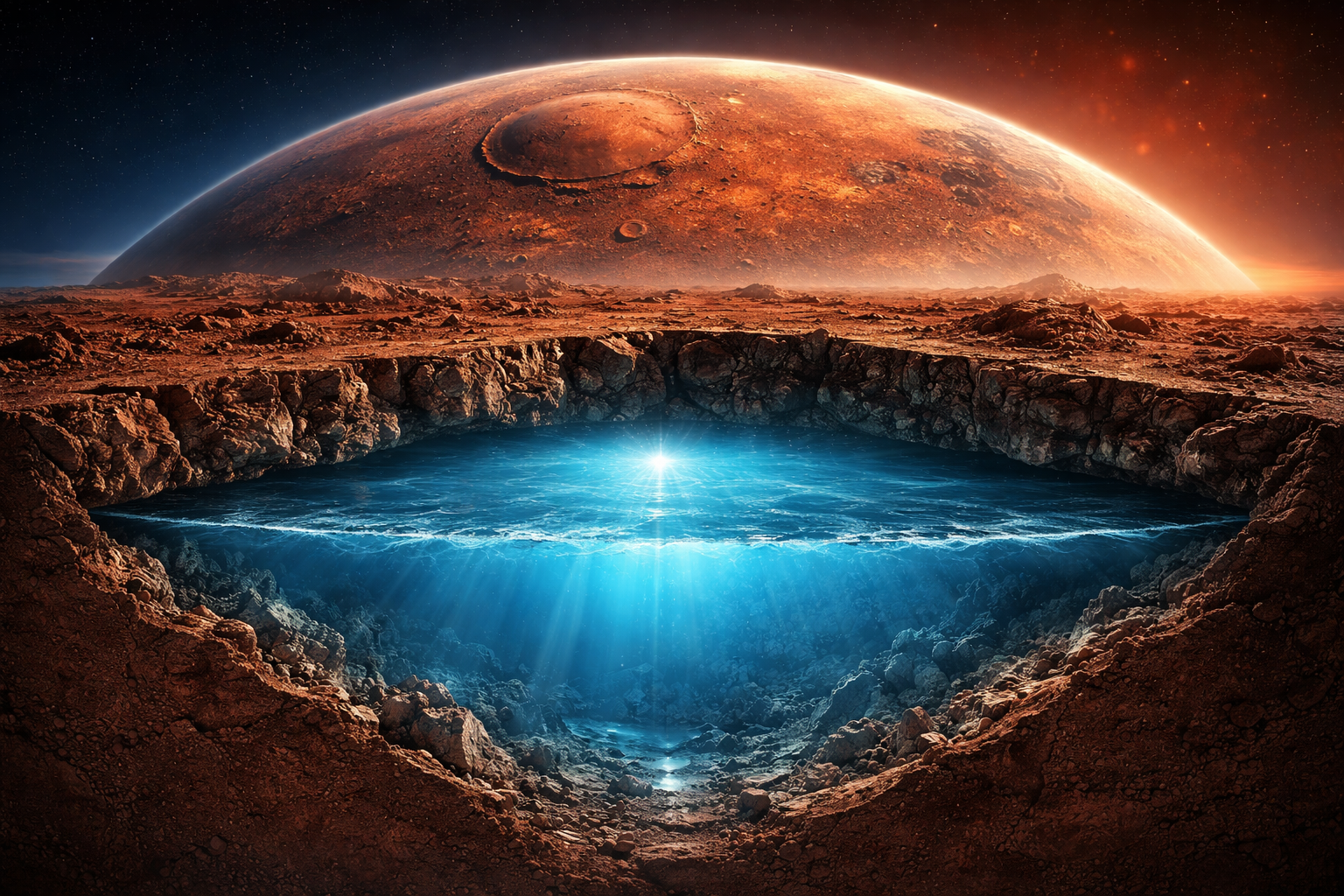
Scientists studying data from Mars missions have uncovered new evidence suggesting the possible existence of a vast underground ocean hidden beneath the surface of Mars. The discovery could significantly change our understanding of the Red Planet and its potential to support life in the distant past.
Researchers analyzing seismic data from NASA’s Mars missions believe that liquid water may exist deep below the Martian crust. The findings have excited planetary scientists because water is considered one of the most important ingredients for life.
For decades, astronomers have suspected that Mars once had rivers, lakes, and even oceans on its surface billions of years ago. The new research now suggests that large quantities of water may still exist beneath the planet’s surface.
Clues from Seismic Data
The discovery comes from data collected by instruments placed on Mars to study the planet’s internal structure. These instruments measure seismic waves that travel through the planet’s crust and mantle.
By analyzing how these waves move through different layers, scientists can estimate what materials exist beneath the surface.
The data appears to indicate the presence of water-rich layers several kilometers below the Martian surface, possibly forming a large underground reservoir.
Such reservoirs could contain enormous amounts of water trapped in porous rock formations.
Why Water on Mars Matters
Water plays a critical role in the search for life beyond Earth. On our planet, every known life form depends on water to survive.
If Mars once had stable liquid water environments, it raises the possibility that microbial life may have existed there at some point in the past.
Even today, underground water could potentially provide environments where simple microbial organisms might survive.
Scientists emphasize that the discovery does not confirm life on Mars, but it does strengthen the case for continued exploration of the planet.
Mars Exploration Continues
Mars remains one of the most studied planets in our solar system. Multiple spacecraft and rovers are currently exploring its surface and atmosphere.
Among them is the Perseverance Rover, which is searching for signs of ancient microbial life and collecting samples that may eventually be returned to Earth.
Future missions by NASA and the European Space Agency are expected to continue investigating the planet’s geology and climate history.
These missions aim to determine whether Mars once had conditions suitable for life.
A Step Closer to Understanding Mars
The possibility of a hidden underground ocean adds another fascinating chapter to the story of Mars exploration.
Scientists believe that understanding where water exists on Mars will help guide future missions, including potential human exploration of the planet.
Water could eventually serve as a resource for astronauts by providing drinking water, oxygen, and even rocket fuel through chemical processing.
As technology advances, the search for water and possible life on Mars will remain one of the most exciting areas of space research.
The discovery of underground water reservoirs does not just tell us about Mars—it also helps scientists understand how planets evolve and how habitable environments may develop elsewhere in the universe.
Discoveries on Mars also help scientists understand how planets formed and evolved across the universe. Readers interested in cosmic origins can explore our article The Big Bang: The Moment When Nothing Became Everything.
Space exploration efforts are accelerating worldwide. Recently we also reported how India Prepares New Space Mission to Study the Sun, highlighting the growing role of international space agencies in solar research.
Source: NASA Mars exploration program
Read More: Latest News
Read More Interesting Content in My Blog Section of ‘The Thrive Journey’.