







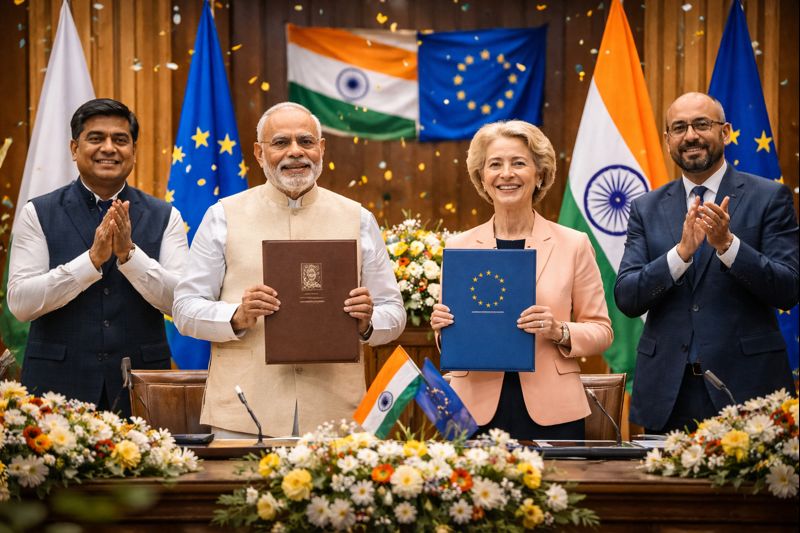
New Delhi — In a major development that analysts are calling the “mother of all deals,” India and the European Union (EU) have concluded a landmark Free Trade Agreement (FTA) after nearly two decades of negotiations. The pact — one of India’s largest ever — is expected to significantly deepen trade and economic ties between India and the 27-member European bloc, covering nearly two billion people and an estimated 25% of global GDP.
What the Deal Is
The India-EU FTA eliminates or drastically reduces tariffs on the majority of traded goods and services between India and the EU. Indian officials and EU leaders alike have described it as historic and ambitious, with broad implications for global trade, supply chains, technology cooperation, and economic growth.
According to the agreement:
Tariffs on nearly 99.5% of Indian exports to the EU will be reduced or eliminated, opening access to a massive market for goods ranging from textiles and leather to marine products and handicrafts.
India will reciprocate with tariff concessions on a significant portion of EU exports, enhancing market access for European manufacturers and service providers.
Strategic Importance
European Commission President Ursula von der Leyen hailed the pact as one of the most significant bilateral agreements in decades, signalling stronger cooperation between two major democratic economies. India’s Prime Minister Narendra Modi called it a transformative moment for India’s role in global trade and economic diplomacy.
The timing is also geopolitically important: with global trade uncertainties and rising protectionist policies, this agreement is seen as a strategic hedge that could help both India and the EU diversify economic partnerships beyond traditional frameworks.
Key Benefits and Impacts
Experts and trade analysts outline several major benefits:
Boost to exports: Indian exporters in sectors like textiles, gems and jewellery, leather, and marine products are expected to benefit from duty-free access to the EU market.
Services and mobility: The pact includes provisions for expanded cooperation in services, technology, and mobility of skilled professionals.
Supply chain resilience: The agreement strengthens supply chain integration across Asia and Europe, reducing dependencies on traditional trade routes.
Analysts also note potential competitive pressure in sectors where tariff reductions expose domestic industries to stronger foreign competition — particularly in automobiles, machinery, and certain processed goods.
Looking Ahead
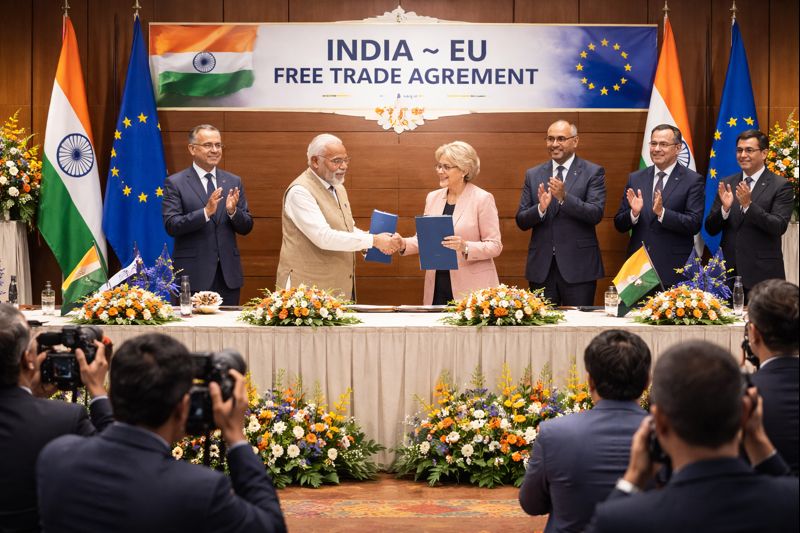
The India-EU Free Trade Agreement is expected to be ratified and gradually implemented over the coming year. Trade experts believe that it will not only accelerate bilateral economic growth but also set a broader template for India’s future engagement with other major economies.
In a statement marking the occasion, Indian officials emphasized that the pact reflects shared democratic values, economic ambition, and strategic cooperation, reinforcing India’s position as a pivotal global trade partner in the 21st century.
Source: India-EU trade deal called ‘mother of all deals’
Read More: Latest News