




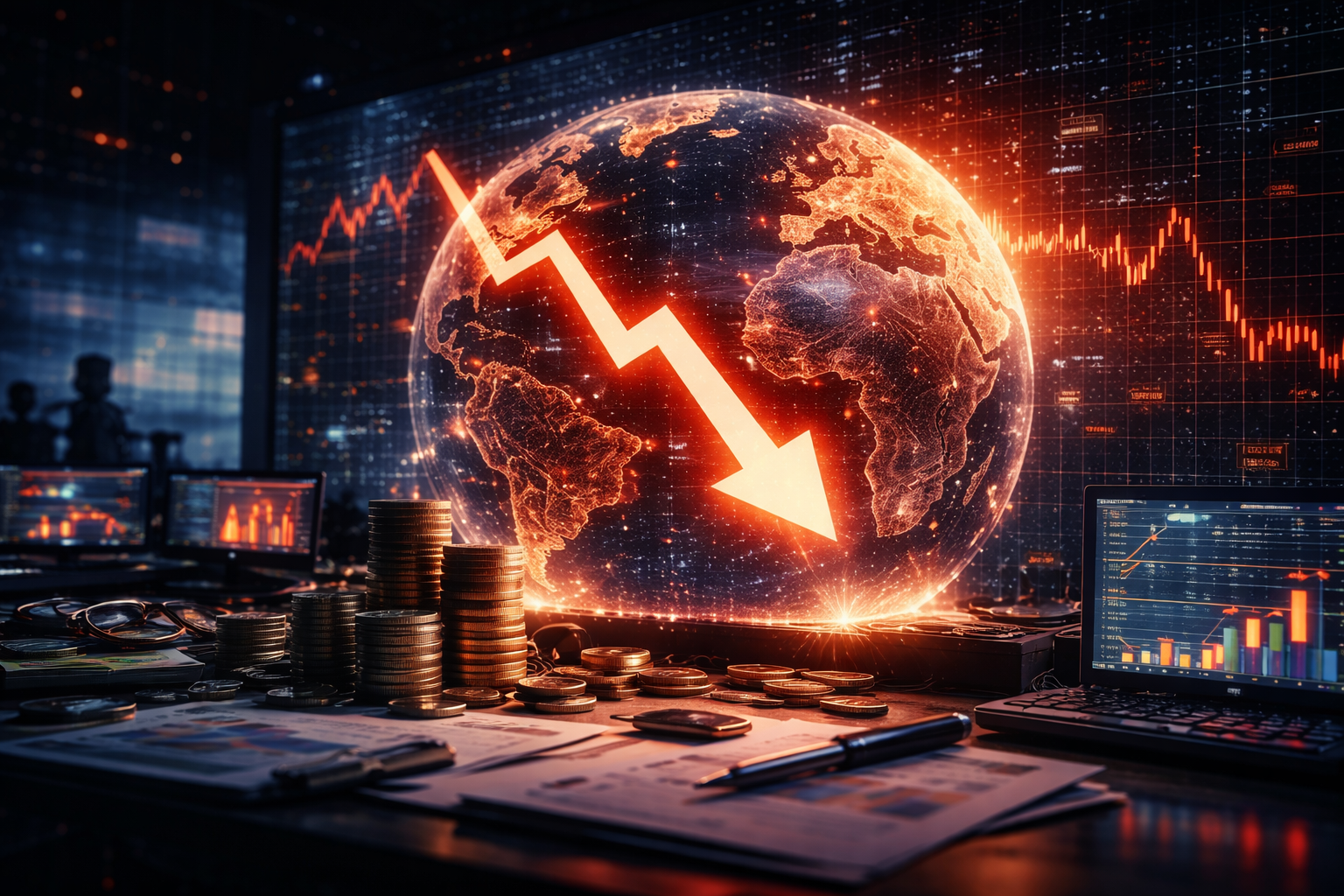
Global economic indicators are showing signs of stress, with inflation pressures, slowing growth, and geopolitical tensions raising concerns about a possible worldwide slowdown in the coming months.
The global economy is once again under the spotlight as economists and financial institutions raise concerns about a potential slowdown. After a period of post-pandemic recovery, several warning signals are now emerging across major economies, suggesting that growth may not be as stable as previously expected.
From rising inflation and interest rate pressures to geopolitical uncertainties and supply chain disruptions, the global economic landscape appears increasingly fragile.
📉 Slowing Growth Across Major Economies
Recent data from leading economies, including the United States, China, and parts of Europe, indicate a noticeable slowdown in economic growth. Manufacturing activity has weakened, consumer spending is showing signs of fatigue, and business investments are becoming more cautious.
In many countries, central banks have maintained high interest rates to combat inflation. While this has helped stabilize prices, it has also slowed borrowing and spending—two critical drivers of economic growth.
💸 Inflation and Interest Rate Pressure
Inflation continues to remain a key concern globally. Although price increases have moderated in some regions, they are still above pre-pandemic levels.
To control inflation, central banks have adopted tighter monetary policies, including raising interest rates. However, this approach comes with a trade-off: higher borrowing costs can reduce business expansion and consumer spending.
This delicate balance between controlling inflation and sustaining growth is now becoming a major challenge for policymakers worldwide.
🌐 Geopolitical Tensions Adding Uncertainty
Geopolitical developments are also playing a significant role in shaping economic trends. Ongoing conflicts, trade tensions, and policy uncertainties are affecting global markets and investor confidence.
For instance, disruptions in energy supply chains and rising commodity prices have had a ripple effect on multiple industries, from manufacturing to transportation.
A related global concern can also be seen in how large-scale cyber threats are disrupting critical infrastructure, as highlighted in our recent report:
👉 Major cyberattack hits global tech infrastructure — what we know so far
📊 Financial Markets React
Global financial markets have started reflecting these concerns. Stock markets in several regions have shown increased volatility, while investors are shifting toward safer assets such as gold and government bonds.
Currency fluctuations are also becoming more pronounced, particularly in emerging markets, where economic stability is more sensitive to global changes.
Experts warn that if current trends continue, financial instability could spread more broadly, impacting both developed and developing economies.
🧠 Expert Opinions and Predictions
Leading economists suggest that while a full-scale recession is not certain, the risk of a prolonged economic slowdown is increasing.
Some analysts believe that the global economy may enter a phase of “low growth,” where expansion continues but at a much slower pace than expected.
Others warn that unexpected events—such as new geopolitical conflicts or financial crises—could accelerate the downturn.
🌍 The Bigger Picture
The current situation highlights the interconnected nature of the global economy. A slowdown in one region can quickly affect others, making it essential for countries to coordinate policies and strengthen economic resilience.
Interestingly, the growing role of technology and automation is also influencing economic trends. As discussed in our in-depth blog:
👉 How AI is used in Everyday Life
technological advancements are reshaping industries, which can both create opportunities and introduce new economic challenges.
According to the International Monetary Fund (IMF), global growth is expected to remain moderate due to inflation pressures and financial uncertainties:
Source: International Monetary Fund (IMF)
Read More: Latest News
Read More Interesting Content in My Blog Section of ‘The Thrive Journey’.