









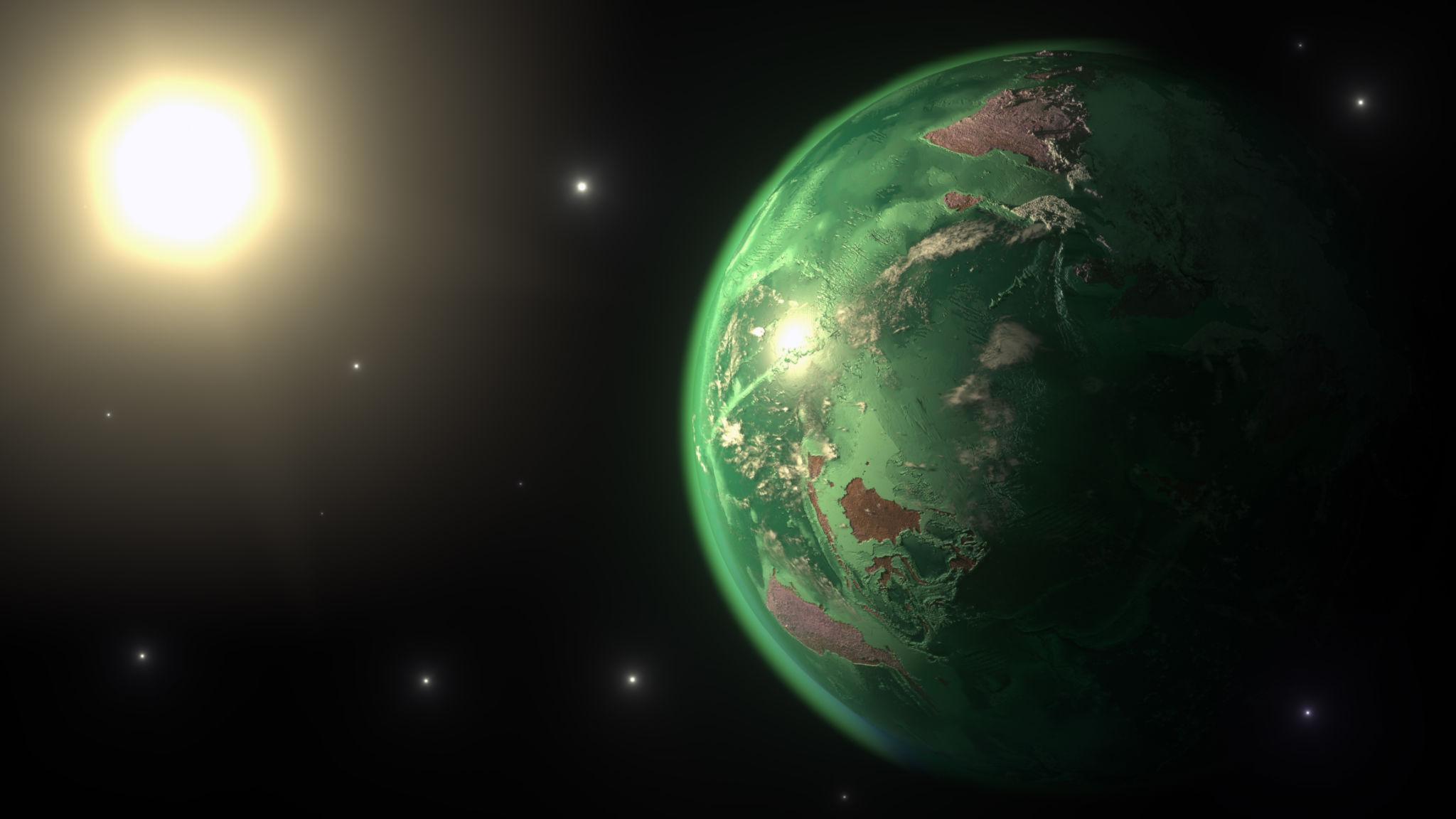
Scientists at NASA have announced the discovery of a new Earth-like exoplanet located about 120 light-years away, raising fresh excitement in the global scientific community about the possibility of life beyond our solar system.
The discovery was made using advanced observations from the James Webb Space Telescope and earlier data gathered by the Transiting Exoplanet Survey Satellite. Scientists say the newly detected planet appears to have several characteristics similar to Earth, including a size comparable to our planet and an orbit that lies within the habitable zone of its host star.
The habitable zone is the region around a star where temperatures could allow liquid water to exist on a planet’s surface—an essential condition for life as we know it.
A Major Step in the Search for Life
The newly discovered world belongs to a category known as exoplanets, which are planets that orbit stars outside our solar system. Over the past two decades, astronomers have discovered thousands of such planets, but only a small number appear to be potentially habitable.
Researchers involved in the project say this latest discovery is particularly interesting because the planet’s mass, atmosphere, and orbital distance make it one of the more promising candidates for future habitability studies.
Astronomers are now analyzing data to determine whether the planet’s atmosphere contains gases such as oxygen, methane, or carbon dioxide, which could indicate biological activity.
Role of Advanced Space Telescopes
The discovery highlights the growing power of modern space telescopes and observation technology. The James Webb Space Telescope, launched in 2021, has dramatically improved scientists’ ability to analyze distant planets and their atmospheres.
Unlike earlier telescopes, Webb can observe infrared wavelengths that allow astronomers to detect chemical signatures in planetary atmospheres. These observations help scientists determine whether planets may have environments suitable for life.
In addition to Webb, the Transiting Exoplanet Survey Satellite (TESS) continues to scan large areas of the sky, identifying potential planets by detecting tiny drops in starlight when a planet passes in front of its star.
Expanding Humanity’s Cosmic Perspective
The discovery of Earth-like planets is part of a broader scientific effort to understand our place in the universe. Over the years, astronomers have found planets larger than Jupiter, rocky worlds similar to Earth, and even planets that orbit multiple stars.
Each discovery brings researchers closer to answering one of humanity’s most profound questions: Are we alone in the universe?
Scientists emphasize that discovering an Earth-like planet does not necessarily mean life exists there. However, it significantly increases the number of worlds where life could potentially develop.
Future Missions and Exploration
Future space missions planned by NASA and international space agencies aim to study exoplanets in even greater detail. Next-generation telescopes will be capable of directly imaging distant planets and analyzing their atmospheres with unprecedented precision.
These missions may one day allow scientists to detect biosignatures, which are chemical signs that life could be present.
The discovery of another potentially habitable planet therefore represents not just a scientific milestone but also a reminder of how much remains to be explored in the vast universe.
Space discoveries continue to change our understanding of the universe. Readers interested in cosmic origins can explore our article The Big Bang: The Moment When Nothing Became Everything
Source: NASA research on Earth-like exoplanets
Read More: Latest News
Read More Interesting Content in My Blog Section of ‘The Thrive Journey’.